I had an interesting exchange with a follower of Steve Sailer on Twitter recently.
I had created a new Twitter account to avoid the inconvenience of my Pinkerite1 account being blocked on Twitter by Steve Sailer, Razib Khan and Steven Pinker.
The new account was also soon blocked by all three, but before it was blocked, I used the account to question Sailer.
Back in April 2019, Sailer tweeted this at me, before blocking my Pinkerite1 account:

So with my new, as-yet-unblocked account, I questioned Sailer about this. I did not receive a response from Sailer but by someone I might call Sailer's assistant.
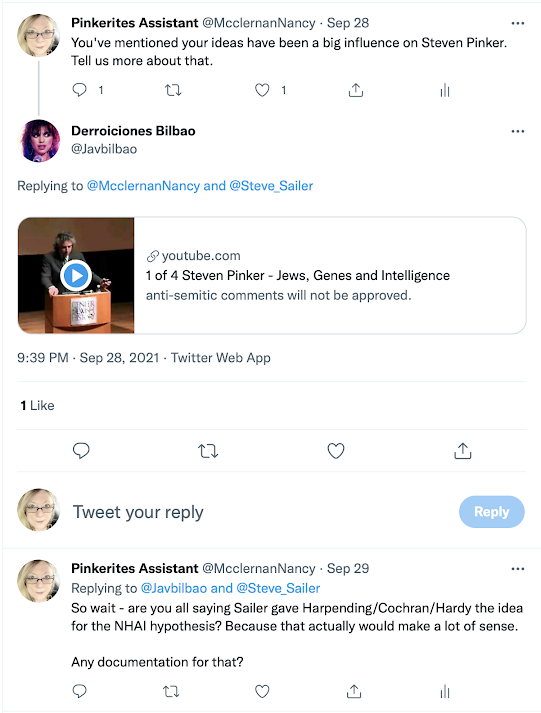
"Derroiciones Bilbao" is a pseudonymous right-wing pro-Trump Twitter account that tweets in Spanish. Since it is a rando account there's no way to find out what the exact connection the person(s) behind it has to Sailer.
But Sailer clicked Like on the tweet, so I assume that was his admission that the claim is correct.
The video Sailer's assistant shared was to a 2008 talk Pinker gave on the subject of "Jews, Genes and Intelligence" which was connected to the 2004 paper "Natural History of Ashkenazi Intelligence."
Steven Pinker has been a long-time promoter of the paper written by Gregory Cochran and the late Henry Harpending. The NHAI hypothesis was debunked by anthropologist Brian Ferguson (which is why Cochran hates him) and geneticist Adam Rutherford.
I decided to do some digging into the connection between Sailer, Cochran and Harpending. And I found they go way back. On his Unz-sponsored blog back in 2002 Sailer mentions not only "two friends of (his)", Harpending and Cochran but he also mentions Andrew Sullivan, and testifies again to his influence over Steven Pinker's views:
The Human Biodiversity Reading Club: I thought I would start to periodically list important articles and books I’m reading in order to generate discussion about them. Andrew Sullivan’s been doing this for a few weeks and is making rather a lot of money off the little kickback that Amazon gives you for touting books. Good for Andrew. It’s one of the best ideas yet for making money off personal web journalism.I’m going to start off, however, with something free, a 7-page article called "In Our Genes," which proposes a "model system for understanding the relationship between genetic variation and human cultural diversity." A rather interesting and important topic, no?It’s by two friends of mine, Henry Harpending of the U. of Utah, who is a rare combination of mathematical geneticist and field anthropologist (inventor of the important Dad vs. Cad distinction), and by Greg Cochran, the brilliant rocket scientist turned evolutionary theorist. The title is a pointed rejoinder to Not in our Genes, the famous anti-sociobiological tract by the neo-Lysenkoist scientists Richard Lewontin, Steve Rose, and Leon Kamin, although it’s also an attack on the evolutionary psychology party line handed down by John Tooby and Leda Cosmides, which Steve Pinker enthusiastically summed up as "differences between individuals are so boring!" (I’ve since managed to persuade Steve that differences between individuals are a tiny bit interesting.)
In the last paragraph, "an attack on the evolutionary psychology party line handed down by John Tooby and Leda Cosmides" refers to the split in sociobiology. One side of sociobiology - the Tooby/Cosmides side - claimed women have evolved to be inferior to men, while the Sailer/Harpending/Cochran side claimed that women and all Black people evolved to be inferior to white men.
Sailer demonstrated how that logic works in action, in an article about Michael Jordan in the National Post of Canada in 1999:
Interestingly, while blacks tend to be more masculine in physique and personality than whites or East Asians, they are often better at typically feminine, more subjective cerebral skills like verbalization, emotional intuition and expression, sense of rhythm, sense of style, improvisation, situational awareness, and mental multi-tasking.
It makes sense from a sociobiology perspective, which believes that our society, as it is now, is the direct result of evolutionary processes, not history and politics. Sailer just makes the next sociobio-logical leap and claims that Black men have feminine, non-logical brains.
Please note Sailer said all of this before Pinker decided to publish a piece of crap, authored by Sailer in "The Best Science and Nature Writing" in 2004.
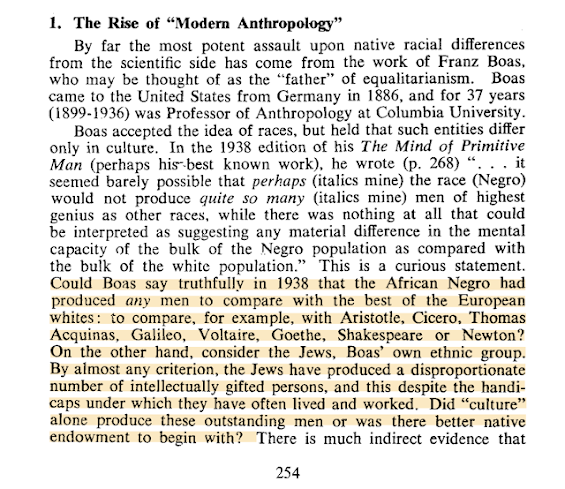
The claim that Black people are biologically stupid is one side of the Sailerite sociobiology coin. The other side is the claim that Jews are biologically smart.
This coin was in currency among racists at least sixty years ago, as demonstrated by Henry Garrett, writing in Mankind Quarterly (funded by the Pioneer Fund) in 1961:
Steve Sailer's friends, Henry Harpending and Gregory Cochran simply took the racists' claim that Jews are innately "intellectually gifted" and attempted to invent a "scientific" explanation.
And when Harpending and Cochran* published their paper "Natural History of Ashkenazi Intelligence" in 2004, Steven Pinker began promoting it, as can be seen in his presentation to the Yivo Institute for Jewish Research, "Jews, Genes and Intelligence" which I will talk about soon.
---------------------
*And Harpending's student, Jason Hardy who appears to have very little connection to sociobiology outside of this paper.