Featured Post

PZ Myers dissects evolutionary psychology: brief, sharp and fabulous

I admit I LOL'd at the part about lighting up "like a Christmas tree." WATCH AND LEARN all IDWs! (If you get that annoying...

~ PINKERITE TALKS TO ANTHROPOLOGISTS ~
The Brian Ferguson Interview
--------------------------------------------------------------------
Showing posts sorted by date for query baffled. Sort by relevance Show all posts

Saturday, December 11, 2021

Pinker: the left is "out to lunch" to attribute crime to poverty and racism


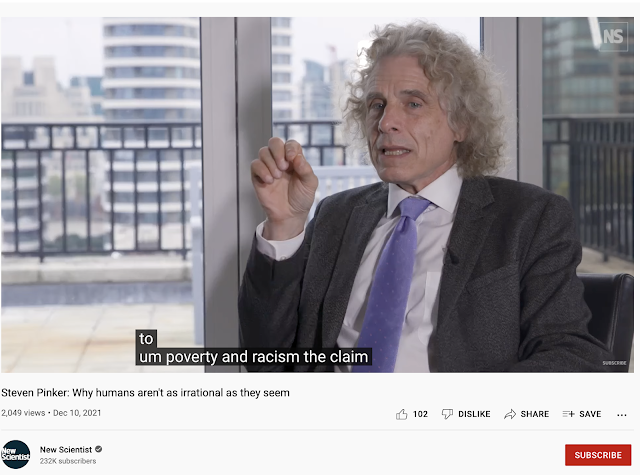
During a mercifully brief interview with Graham Lawton of New Scientist, Steven Pinker, the world's most annoying man, compared the belief that crime is caused by poverty and racism to climate change denial.
...scientists are often surprised that there is so much denial... and it is sometimes attributed to scientific uh ignorance or scientific illiteracy... as it turns out itself a uh less than rational belief because it's not based on empirical studies of why people deny climate change... and what those studies show is that the deniers are actually no more ignorant of science than the believers, in fact a lot of people who endorse the scientific consensus are really uh out to lunch when it comes to the science of climate change, they think it has something to do with the ozone hole and toxic waste dumps plastic straws in the ocean. 

What does predict people's belief in climate change is just their politics the farther you are to the right the more denial there is.

Now that's a case in which the scientifically respectable conclusion is aligned with the left but there are also cases that go the other way, where it's the the uh the left that's out of touch with the scientific facts. 
The left was uh completely out to lunch when it came to... the um causes of crime, badly badly wrong when it uh - it still does... when it attributes crime to um poverty and racism...


But since the media almost always treats Pinker's utterances as unquestionable pearls of scientific wisdom, Lawton did not ask Pinker what he thinks is the true cause of crime.

I looked around for other instances of Pinker discussing crime, and found a Pinker interview from May with his fellow Quillette author Coleman Hughes. While Hughes is a Black American, he is also an apologist for race pseudoscience and a Koch employee, via the Koch-funded City Journal, and I wondered if Pinker was going to go all-in on a race pseudoscience explanation for crime.

Instead what I found was Pinker said something different about racism and crime:

HUGHES

...But I want to ask now a deep and basic question relating to human nature and a kind of fundamental disagreement on what human nature is and how that relates to violence. And and the question, which is deceptively simple, is: "What is the cause of crime? What causes people to commit crime? Does the question make sense? If so, why or why not?" And just how do you view that--because and the context is, most people I talk to about this issue take it for granted that crime is, you know, we know the causes of crime--poverty, inequality, systemic bias, hopelessness, despair. And I have no doubt that that is true in some cases, but I - I - I've been persuaded by by by many arguments that sort of hold that human nature can can kind of just tend towards this to begin with. 

So, where do you stand on that? And how do you, how do you think of that? 

PINKER

Yeah, there are ah, there different kinds of crime and there are different people who commit them out of different motives. Generally, it's certainly true that a lot of crime occurs in poor neighborhoods. And poor people are more likely to commit violent crime. It's not true, necessarily true of violence in general, especially through history when it used to be the aristocrats that had their armed retinues and would engage in contests of honor and revenge, dueling men men of honor as in the opening scene of Romeo and Juliet when two aristocratic families have a a street fight. 

So it's, that's not a given, but it tends to be true now. In general it's--although there are many causes of crime--they're not all racism and inequality, the ah especially not when it comes to changes over time.


So apparently Pinker does think that racism and poverty are causes of crime, just not the only ones. 

It would appear that in May 2021, Steven Pinker did not believe "leftists" were incorrect to the point of climate-change-denial-incorrectness. But in December 2021 he did.

Did Steven Pinker change his mind between the May and December? Or is this yet one more example of weak and strong pinkerism

Did Pinker change his response based on his audience, the way Pinker's buddy Razib Khan did on the issue of "white supremacy"?

Pinker's interview with Hughes demonstrates Pinker's utter obtuseness - it must be based on his own political leanings - when it comes to data:
PINKER 
...The great American crime decline, which began in 1992, which saw rates of violent crime plunge to half their levels in you know, in New York it plunged 75 percent. This was during a period of rising inequality. And even though there've been there was a slight deep systemic decrease in racism--not enough to have brought crime rates down that quickly, 50 percent in eight years...

We saw in "Better Angels" that Pinker attributed Black American high crime rates to low Black marriage rates. In spite of the data showing the opposite - marriage rates fell along with crime rates.

Pinker doesn't say what metric he is using to determine "inequality" here. But we do have one useful metric, which involves looking at data, so maybe that explains why Pinker missed it: 


And Black unemployment rates, while historically higher than white unemployment, also fell at the same time.


Seriously, what is wrong with Steven Pinker? Is he incapable of the tiniest effort to find data?

I'm not the first to be baffled by Steven Pinker. Way back nineteen years now, Louis Menand wrote the perfect Pinker review and said:

...Having it both ways is an irritating feature of "The Blank Slate." Pinker can write, in refutation of the scarecrow theory of violent behavior, "The sad fact is that despite the repeated assurances that 'we know the conditions that breed violence,' we barely have a clue," and then, a few pages later, "It is not surprising, then, that when African American teenagers are taken out of underclass neighborhoods they are no more violent or delinquent than white teenagers." Well, that should give us one clue...

The paragraph captures the "having it both ways" phenomenon seen repeatedly in Pinker's public opinions.

In the Hughes interview, right after Pinker claimed, without evidence, that inequality rose after 1992, he said this:

And even though there've been there was a slight deep systemic decrease in racism--not enough to have brought crime rates down that quickly, 50 percent in eight years--a lot of crime is opportunistic. People, there's a strong correlation between people who commit crime and lack of self-control.

Now "self-control" is a favorite subject of the biosocial criminologists, and they believe Black people possess less of it. As the reliably blunt rightwing biosocial criminologist John Paul Wright wrote:
While self-control is an important executive function, so, too, is intelligence. Indeed, there is no other individual variable as studied as intelligence. While hotly debated, thousands of studies of millions of individual intelligence scores indicate that IQ follows traditional racial categories (Rushton & Jenson, 2005). Asians have an average IQ of 106, Caucasians 100, and Blacks 85 (Lynn, 2006; Sarich & Miele, 2004)…

...Self-control and IQ covary, so that individuals with low self-control are also more likely to have low IQ. These deficits are potent enough to predict many of the negative life-course factors that afflicted individuals will experience. Longitudinal analyses of cohorts of individuals demonstrate that these individuals will face multiple problems across their life- course and that their self-limiting choices will show a high degree of continuity. Most will fail at their education and will then encounter problems in employment… They likely will live a fluid existence, relocating from place to place but often within the same economic stratum (Wright & decker, 1997). Finally their relationships will frequently be marred by conflict, unfaithfulness and unreliability. This pattern holds for anyone with deficits in executive control functions, black, white or Asian, but due to the distribution of low IQ and low self- control found in black populations, it is more often reflected in the lives of blacks.

And
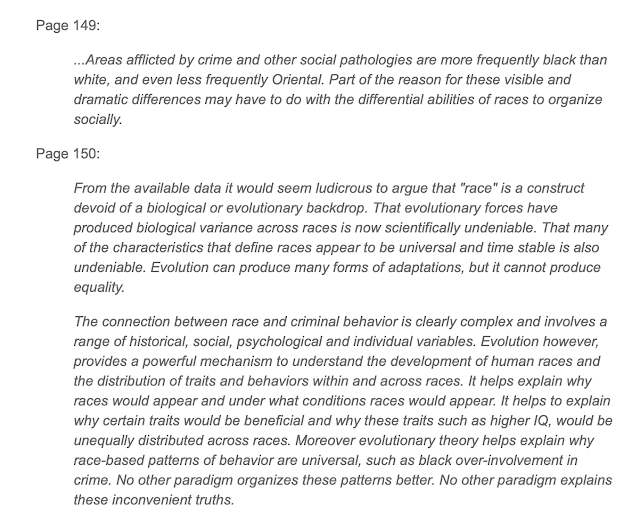
Those passages were published in "Biosocial Criminology: New Directions in Theory and Research" edited by Anthony Walsh and Kevin Beaver.

I was aware that Steven Pinker promoted Brian Boutwell, a biosocial criminologist, but I wasn't aware how connected Pinker was to biosocial criminology until recently. I will be discussing that soon.

Tuesday, April 6, 2021

So why is Koch so bad?

Illustration from The Economist article Kochtopus's Garden

I make a big deal about all the connections between Steven Pinker and his friends and Charles Koch. But why? What's so bad about Koch

I was first alerted to the awfulness of Charles Koch - or rather the Koch brothers because David Koch was still alive then - thanks to Jane Mayer's 2010 New Yorker piece
Covert Operations The billionaire brothers who are waging a war against Obama

From the piece:

The Kochs are longtime libertarians who believe in drastically lower personal and corporate taxes, minimal social services for the needy, and much less oversight of industry—especially environmental regulation. These views dovetail with the brothers’ corporate interests. In a study released this spring, the University of Massachusetts at Amherst’s Political Economy Research Institute named Koch Industries one of the top ten air polluters in the United States. And Greenpeace issued a report identifying the company as a “kingpin of climate science denial.” The report showed that, from 2005 to 2008, the Kochs vastly outdid ExxonMobil in giving money to organizations fighting legislation related to climate change, underwriting a huge network of foundations, think tanks, and political front groups. Indeed, the brothers have funded opposition campaigns against so many Obama Administration policies—from health-care reform to the economic-stimulus program—that, in political circles, their ideological network is known as the Kochtopus.

And...

The brothers realized that their brand of politics didn’t sell at the ballot box. Charles Koch became openly scornful of conventional politics. “It tends to be a nasty, corrupting business,” he told a reporter at the time. “I’m interested in advancing libertarian ideas.” According to Doherty’s book, the Kochs came to regard elected politicians as merely “actors playing out a script.” A longtime confidant of the Kochs told Doherty that the brothers wanted to “supply the themes and words for the scripts.” In order to alter the direction of America, they had to “influence the areas where policy ideas percolate from: academia and think tanks.”

And...

The Kochs have long depended on the public’s not knowing all the details about them. They have been content to operate what David Koch has called “the largest company that you’ve never heard of.” But with the growing prominence of the Tea Party, and with increased awareness of the Kochs’ ties to the movement, the brothers may find it harder to deflect scrutiny. Recently, President Obama took aim at the Kochs’ political network. Speaking at a Democratic National Committee fund-raiser, in Austin, he warned supporters that the Supreme Court’s recent ruling in the Citizens United case—which struck down laws prohibiting direct corporate spending on campaigns—had made it even easier for big companies to hide behind “groups with harmless-sounding names like Americans for Prosperity.” Obama said, “They don’t have to say who, exactly, Americans for Prosperity are. You don’t know if it’s a foreign-controlled corporation”—or even, he added, “a big oil company.” 

The Kochs were not happy about the article and tried to retaliate against Mayer according to a NYTimes article What Happened to Jane Mayer When She Wrote About the Koch Brothers.

Eleven years later, David Koch is dead but Charles Koch is still at it. And it appears that what Charles Koch has decided is that since voters don't like libertarian ideas, the real problem is democracy itself. Mayer recently wrote again for the New Yorker about Koch:

A recording obtained by The New Yorker of a private conference call on January 8th, between a policy adviser to Senator Mitch McConnell and the leaders of several prominent conservative groups—including one run by the Koch brothers’ network—reveals the participants’ worry that the proposed election reforms garner wide support not just from liberals but from conservative voters, too. The speakers on the call expressed alarm at the broad popularity of the bill’s provision calling for more public disclosure about secret political donors. The participants conceded that the bill, which would stem the flow of dark money from such political donors as the billionaire oil magnate Charles Koch, was so popular that it wasn’t worth trying to mount a public-advocacy campaign to shift opinion. Instead, a senior Koch operative said that opponents would be better off ignoring the will of American voters and trying to kill the bill in Congress.

But they have a plan - phony bipartisanship:

On the call, McKenzie, the Koch operative, cited one “ray of hope” in the fight against the reforms, noting that his research found that the most effective message was arguing that a politically “diverse coalition of groups opposed” the bill, including the American Civil Liberties Union. “In our message example that we used, we used the example of A.C.L.U., Planned Parenthood, and conservative organizations backed by Charles Koch as an example of groups that oppose H.R. 1,” he said. “I think, you know, when you put that in front of people . . . they’re, like, ‘Oh, conservatives and some liberal groups all oppose this, like, I should maybe think about this more. You know, there must be bigger implications to this if these groups are all coming together on it.’ ”

However, that test message was inaccurate. Planned Parenthood does not oppose the For the People Act. It is, in fact, on a list of organizations giving the legislation their full backing. And the A.C.L.U. supports almost all of the expansions of voting rights contained in the bill...

I think Koch flunkies got the memo. Just recently I noted that Koch employee and Trump supporter Christopher F. Rufo was trying to pass off FAIR as a bipartisan group when it is clear it is far right-leaning and full of people who take money from Koch-supported organizations.

Mayer and the New Yorker are national treasures for their reporting on Koch. It's curious that the New Yorker is also one of the few media outlets that isn't baffled by Steven Pinker's bullshit - or the bullshit of other Koch-funded grifters.

Monday, April 5, 2021

Steven Pinker and his other connections

I've mentioned here on occasion that Pinker fanboys freak out because I created a diagram (with associated text which they never seem to read) demonstrating Pinker's connections to the Right and/or purveyors of race "science." 

I've also noted previously on this blog that Steven Pinker appears to be a sacred cow of the media, and has escaped serious blow-back for his support of race science in a way that Andrew Sullivan, for example, has not. 

How did Steven Pinker, "celebrity intellectual" achieve this? Even after another celebrity intellectual, Malcolm Gladwell, called out Pinker's promotion of professional racist Steve Sailer, 12 years ago.

I've speculated on this before, suggesting it could be the Pinker PR machine or his lack of intellectual integrity, but another likely reason is that Pinker has the right connections.

In addition to his connections through colleges and connections to rich guys like Jeffrey Epstein and Bill Gates, Pinker is or has been, according to his CV on boards of 76 scientific, scholarly and public interest organizations - most of them are current.

Editorial Boards of Scientific and Scholarly Journals

  1. American Journal of Bioethics: Neuroscience
  2. Canadian Psychology, 2003-.
  3. Cognition, 1982-2008.
  4. Cognitive Science, 1991-1996.
  5. Daedalus, 2002- .
  6. Developmental Review, 2019- .
  7. Earth & Sky, 2007- .
  8. English Linguistics, 2003- .
  9. Essays in Philosophy of Humanism, 2012– .
  10. Evolution and Human Behavior, 1998- .
  11. Evolution and Culture, 2020- .
  12. Evolutionary Psychology, 2001- .
  13. Evolutionary Psychological Science, 2014- .
  14. Intercultural Pragmatics, 2003- .
  15. International Journal of Bilingualism. 1996- .
  16. Journal of Child Language, 1994-2004. 
  17. Journal of Cognition and Culture, 2000- .
  18. Journal of Evolutionary Psychology, 2014- .
  19. Journal of Social, Evolutionary, and Cultural Psychology, 2008- .
  20. Language Acquisition, 1990-2004; Advisory Board, 2004- .
  21. Language and Dialogue, 2010- .
  22. Mind & Society, 2002- .
  23. PLoS ONE, 2006-2015.
  24. PsyCh Journal, 2018- .
  25. Psychonomic Bulletin and Review, 2014- .
  26. The Evolutionary Review, 2008- .
  27. The Humanist, 2007- .
  28. The Scientific Study of Literature, 2010-.
  29. Theoria et Historia Scientiarum: An International Journal for Interdisciplinary Studies, 2000- .
  30. Trends in Cognitive Science, 2000-2010.
  31. Words, 2002- .

Advisory Boards of Scientific, Scholarly, and Public Interest Organizations

  1. Apolitical, 2018- .
  2. Breakthrough Institute, Senior Fellow, 2018- .
  3. Campus Freedom Network, 2009- .
  4. Cellular Agricultural Society, 2020- .
  5. Center for Empathy in International Affairs, 2015- .
  6. Center for Inquiry Canada, 2016- .
  7. Center for Research on Language, Mind, and Brain, McGill University, 2003- .
  8. Cognitive Neuroscience Society, 1994- .
  9. Committee for the Scientific Investigation of Claims of the Paranormal, 1979- .
  10. Counterweight, 2021- .
  11. Cybereditions, 1998- .
  12. The Decade of Behavior, 2003-2005
  13. Diamond Sky Productions/The Day the Earth Smiled, 2013- .
  14. E. O. Wilson Foundation, 2007- .
  15. Endangered Language Fund, 1998- .
  16. English for the Children, 2001-2004.
  17. Environmental Progress, 2016– .
  18. Ford Hall Forum, 2012- .
  19. Foundation for Individual Rights in Education, 2007- .
  20. The Foundations Institute, University of California, Santa Barbara, and Max Planck Society, 2019- .
  21. Global Secular Council for the Scientific Study of Nontheism, 2014- .
  22. HumanProgress.org
  23. Institute for Science and Human Values, 2010- .
  24. International Academy of Humanism, 2010- . 
  25. International Association for the Study of Attention and Performance, 1992- .
  26. Kärnfull Energi, Sweden, Pro Bono Advisory Board, 2020- .
  27. National Writing Project Writers Council, 20106– .
  28. Naturalism Research Project, Center for Inquiry.
  29. NSF Science of Learning Center at Gallaudet University, 2011- .
  30. Office of Public Policy, Center for Inquiry, Washington DC, 2006- .
  31. Origins Project, Arizona State University, 2009- 2018.
  32. Oxford University Press, Heretical Thought series, 2013- .
  33. Paul G. Allen Institute for Brain Science, 2001- .
  34. Peace Research Endowment, 2012- .
  35. Planet Word Museum of Language Arts, 2016- .
  36. Potential Energy, 2019- .
  37. Rock-It Science, 2008- .
  38. Secular Coalition for America, 2007- .
  39. Sesame Workshop, 2012- .
  40. Science for Peace, 2009- .
  41. Science and Entertainment Exchange, National Academy of Sciences, 2008- .
  42. Society for Evolutionary Analysis in Law, 2009- .
  43. Society for Language Development, 2003- .
  44. Student Achievement and Advocacy Services, 2002- .
  45. World Science Festival, New York, 2006- .

In addition to those, he's an Advisor to FAIRHonorary President of the Freedom From Religion Foundation; on the Board of Directors of Ideas Beyond Borders, and likely more.

I see two of the organizations listed by Pinker also have connections to the Right, including Foundation for Individual Rights in Education (FIRE) funded by Koch - I mention FIRE in my Pinker diagram, and Human Progress, also Koch-funded. There are probably more.

I should have been paying better attention because I just noticed Pinker is publishing a new book due in September, Rationality: What It Is, Why It Seems Scarce, Why It Matters. I can't wait for the New Yorker magazine review - the New Yorker is one of the very few publications that isn't baffled by Pinker's bullshit. 

But then, Pinker isn't a New Yorker advisor nor a board member.

Sunday, September 6, 2020

Trump, the IDW and investigating the 1619 project

People associated with the Intellectual Dark Web are on the record as hostile to the 1619 project.

The IDW is associated with many people who promote race science, from Charles Murray to Sam Harris to Steven Pinker to the many authors at Quillette.

I've been noting the hostility of race science promoters to the history of African Americans for years.

We see Sam Harris expressing that hostility in his debate with Ezra Klein (my highlights):

Ezra Klein
...(Charles) Murray does say he thinks that some combination of genetic and basically immutably environmental characteristics make it so we can’t do much about this and there just are big differences between the groups, and it’s just going to remain that way, and American politics need to rearrange itself around that reality. 

Yeah, I strongly disagree, and I disagree because of American history. That is why my fundamental criticism of that conversation was that you needed to deal more with the history of this conversation and the history of this country. 
Sam Harris
Okay, but even in this conversation you are unwilling to differentiate scientific fact and scientific data and reasonable extrapolations based on data, from past injustices in American history, these are totally separate things
 
Ezra Klein
No, we disagree on what a reasonable extrapolation from the data is.

Harris believes that scientific data should be considered "totally separate" from American history as an explanation for African American failure to thrive, post-Emancipation. The late Michael Brooks had an excellent response to Harris's position.

The attitude of race science towards African American history is perhaps most succinctly expressed by race science promoter Razib Khan, on his blog, when he took offense at Carl Zimmer in the New York Times pointing out that many African Americans have European genetic ancestry and that a significant number of white Americans have recent African ancestry.

Khan wrote (my highlight):
What genetics is showing is that in fact white Americans are shockingly European to an incredibly high degree for a population with roots on this continent for 400 years. If we removed all the history that we take for granted we’d be amazed that the indigenous peoples had so little demographic impact, and, that the larger numbers of people of partial African ancestry did not move into the general “white” population. 
Yes, if we could create a context-free scenario that eliminated all knowledge of the one-drop rule and slavery and systemic racism and the collapse of indigenous populations due to European diseases and expansion we would be amazed and baffled and perplexed. That's what lack of information will do to you.

So why even consider this context-free scenario? Because if race science promoters could eliminate knowledge of African America history it would clear the way for an explanation based on genetic inferiority. And then contemporary anti-Black racism could be declared not the result of centuries of systemic racism but rather the fault of Black people themselves.

In Sam Harris's debate with Ezra Klein over Charles Murray, Harris linked to an article in Quillette, A Tale of Two Bell Curves, which demonstrates how extreme are race science beliefs in the genetic explanation of African American failure to thrive. Authors Ben and Bo Winegard claim, using race pseudo-science as justification, that the only explanation is genetics (my highlight):
Of course, there are other possible explanations of the Black-White (intelligence test) gap, such as parenting styles, stereotype threat, and a legacy of slavery/discrimination among others. However, to date, none of these putative causal variables has been shown to have a significant effect on the IQ gap, and no researcher has yet made a compelling case that environmental variables can explain the gap. This is certainly not for lack of effort; for good reason, scholars are highly motivated to ascertain possible environmental causes of the gap and have tried for many years to do just that.
When I asked Ben Winegard about this on Twitter, before he blocked my Pinkerite Twitter account, his response was to claim the Asian American and Jewish American experiences were comparable to the African American experience. He tweeted:
Asian Americans were treated abysmally. And I don't think we need to tarry over the historical treatment of Jewish people.


This bogus equivalence is only possible if you know nothing about the Black experience in North America since 1619 - or you are doing your best to deny the significance of that experience.

One of the things I discovered from doing this blog is how little I knew of the many attacks on African American communities since Emancipation. I did not know about the murder of Blacks and the destruction of "Black Wall Street" in the Tulsa massacre. And that was one of many ignored and under-discussed incidents of African American history.

James Lindsay is obsessed with suppressing 
knowledge of systemic racism.

Not all violence and looting of black wealth has happened on a grand scale, but it has occurred systematically and with impunity as one of the articles in the 1619 project documents:
Elmore Bolling, whose brothers called him Buddy, was a kind of one-man economy in Lowndesboro, Ala. He leased a plantation, where he had a general store with a gas station out front and a catering business; he grew cotton, corn and sugar cane. He also owned a small fleet of trucks that ran livestock and made deliveries between Lowndesboro and Montgomery. At his peak, Bolling employed as many as 40 people, all of them black like him. 

One December day in 1947, a group of white men showed up along a stretch of Highway 80 just yards from Bolling’s home and store, where he lived with his wife, Bertha Mae, and their seven young children. The men confronted him on a section of road he had helped lay and shot him seven times — six times with a pistol and once with a shotgun blast to the back. His family rushed from the store to find him lying dead in a ditch. 
The shooters didn’t even cover their faces; they didn’t need to. Everyone knew who had done it and why. “He was too successful to be a Negro,” someone who knew Bolling told a newspaper at the time. When Bolling was killed, his family estimates he had as much as $40,000 in the bank and more than $5,000 in assets, about $500,000 in today’s dollars. But within months of his murder nearly all of it would be gone. White creditors and people posing as creditors took the money the family got from the sale of their trucks and cattle. They even staked claims on what was left of the family’s savings. The jobs that he provided were gone, too. Almost overnight the Bollings went from prosperity to poverty. Bertha Mae found work at a dry cleaner. The older children dropped out of school to help support the family. Within two years, the Bollings fled Lowndes County, fearing for their lives.
This is the knowledge that the race science promoters of the Intellectual Dark Web want to suppress. And they have found an ally in Donald Trump.

Trump says Department of Education will investigate use of 1619 Project in schools

President Donald Trump is continuing to wage battle against interpretations of history which he claims are un-American.
In a Sunday morning tweet, the President said the US Department of Education would investigate whether California schools are using the New York Times' "1619 Project" in public school curriculum. The Pulitzer-Prize winning collection reframes American history around the date of August 1619, when the first slave ship arrived on America's shores. 
"Department of Education is looking at this. If so, they will not be funded!" he wrote on Twitter, citing a message from an unverified account saying it was being taught in schools there. 
The message came after the President on Friday night banned federal agencies from conducting racial sensitivity training related to "white privilege" and "critical race theory."
Trump's Department of Education is headed by Betsy Devos, who is a fan of race science as evidenced by her citation of the work of "biosocial criminologists" John Paul Wright, Kevin Beaver, J. C. Barnes, Michelle A. Coyne and Mark Alden Morgan. She used their work to make claims about Black children.
In making the latter point, DeVos' commission cited several times a study in which researchers argued that the discipline discrepancies between black and white students are "likely produced by pre-existing behavioral problems of youth that are imported into the classroom, that cause classroom disruptions, and that trigger disciplinary measures by teachers and school officials...
...Early misbehavior is tied to later misbehavior and, in turn, that misbehavior is tied to school suspensions," the researchers concluded. "These findings highlight the importance of early problem behaviors and suggest that the use of suspensions by teachers and administrators may not have been as racially biased as some scholars have argued."
The paper's claim that there is no racial bias in the punishment of Black children seems extremely implausible. But I don't think it's impossible that there could be a bit more discipline problems with Black children, because Black children are more likely to come from poor homes and poverty is associated with bad behaviors.

And if you know African American history, which involved not only discrimination but terrorism and looting and practices like housing discrimination that continue right up to the present day, you know why Black children are more likely to come from poor homes.

The actual problem is that John Paul Wright and friends consider Black misbehavior not the result of socio-economic conditions but a sign there is something innately more criminal and less intelligent about Black people due to their own genetics.

As John Paul Wright bluntly explains in his chapter "Inconvenient Truths: Science, Race, and Crime" in Biosocial Criminology: New Directions in Theory and Research edited by Anthony Walsh and Kevin M. Beaver (my highlight):
Page 149: 
...Areas afflicted by crime and other social pathologies are more frequently black than white, and even less frequently Oriental. Part of the reason for these visible and dramatic differences may have to do with the differential abilities of races to organize socially. 
Page 150: 
From the available data it would seem ludicrous to argue that "race" is a construct devoid of a biological or evolutionary backdrop. That evolutionary forces have produced biological variance across races is now scientifically undeniable. That many of the characteristics that define races appear to be universal and time stable is also undeniable. Evolution can produce many forms of adaptations, but it cannot produce equality.  
The connection between race and criminal behavior is clearly complex and involves a range of historical, social, psychological and individual variables. Evolution however, provides a powerful mechanism to understand the development of human races and the distribution of traits and behaviors within and across races. It helps explain why races would appear and under what conditions races would appear. It helps to explain why certain traits would be beneficial and why these traits such as higher IQ, would be unequally distributed across races. Moreover evolutionary theory helps explain why race-based patterns of behavior are universal, such as black over-involvement in crime. No other paradigm organizes these patterns better. No other paradigm explains these inconvenient truths.
Just like Bo and Ben Winegard in Quillette, John Paul Wright declares that there is no other explanation other than "evolutionary theory" for Black crime rates.

Wright has also written for Quillette and appeared as a guest on white supremacist Stefan Molyneux's channel.

The Intellectual Dark Web and Donald Trump want to suppress the 1619 project, because it runs contrary to the race science narrative that there is no other explanation for African American failure to thrive besides "evolutionary theory."

Thursday, July 23, 2020

Chotiner v Williams: the New Yorker comes through again

CHOTINER FOR 
THE WIN


So I am pleased but not necessarily surprised that the one media outlet that made an effort to seriously and critically examine the claims of Thomas Chatterton Williams is the New Yorker, in this interview Williams did with Isaac Chotiner.

I had already observed Williams' Koch connection. I think we'll be seeing Williams' Quillette byline any day now.

UPDATE: I was wrong about the Quillette byline - instead Williams got a job with the Koch-funded American Enterprise Institute (AEI.)

The Twitterati had some good takes:


I suspect Williams was so bad at answering Chotiner's questions because Williams did the letter on behalf of a right-wing grift.


But the best tweet is the moral of this story.

Friday, December 13, 2019

Miffed at the New Yorker, Steven Pinker calls for backup from racist Razib Khan

This is a repost from my personal blog originally posted November 2011

Since the earliest days of this blog I've had my eye on Razib Khan, the bigwig at Gene Expression the web site devoted to the "science" of evolutionary psychology. The very first time I mentioned Khan was to point out that he is a blatant racist and a big admirer of Steven Pinker - and it was obvious to me even then that Pinker returned the admiration. Here's Khan talking about aptitude:
I believe different groups probably have different aptitudes (not moral inferiority or superiority)-and the axiom of equality-that all groups have the exact same tendencies as our common evolutionary heritage, could cause serious problems when applied to public policy.
Now what Khan means by "aptitude" is intelligence and what he has in mind is that infamous work of racialist science "The Bell Curve." Predictably, Khan is a huge fan of the Bell Curve and featured this interview with author Charles Murray.

Another time Khan clarified further on the "aptitude" issue:
right now, we assume that ALL GROUPS HAVE EQUAL APTITUDES. the result is that liberals devise new social programs to “uplift” groups to express their potentional. conservatives excoriate underclass social structures and cultures and encourage their own rival social engineering programs (vouchers, enterprise zones, privating public housing). if some aptitudes were genetic on average between groups, then we have an even harder task: identify the points in the genome that effect “g”-general intelligence, and figure out ways to manipulate these segments of the genome (gene therapy).
There is no question, Razib Khan believes that non-whites, especially Africans, have evolved to be less intelligent than whites. He is a full-on racist.

Here Khan lays out his theories of intelligence of various national/ethnic groups and the desirability of blondes.

UPDATE DECEMBER 14:
In the link above Khan presents the race science belief that Native Americans are a separate race from East Asians. Pinkerite has recently discussed the why that is genetically incorrect.


The proudly racist American Renaissance likes to republish the work of Razib Khan.

But Khan is careful not to make his racism too blatant these days. Instead he lets you draw your own conclusions about Black Americans as in this Discover Magazine column he writes:
Here’s a case of inversion: in the early 20th century ideologues turned the roots of all civilizations into examples of Aryan/Nordic superiority. Today from what I can tell the mainstream sentiment is to not comment or inquire too deeply into the Afrocentrist fiction that St. Augustine, Hannibal or Cleopatra were black. A fiction which from what I can tell has spread widely within the African American community. How the pendulum has swung!
So how does he know that the fiction "has spread widely within the African American community"? He says it right there: "from what I can tell."

In other words, the Aryan/Nordic superiority myth, which was widely disseminated and believed and acted upon in the Holocaust, is equivalent to the myth-making of the African American community - from what Razib Khan can tell.

According to his online bio he is an "Unz Foundation Junior Fellow." The Unz Foundation was created by Ron Unz, publisher of The American Conservative.

Now it's not surprising that Pinker has a hissyfit over the New Yorker review of his most recent book "The Better Angels of Our Nature: Why Violence Has Declined." - Pinker is not accustomed to analysis by someone who is not baffled by his bullshit - and legions in the media are. Pinker is accustomed to being lionized and revered.

So who does Steven Pinker turn to for a reply to The New Yorker? Razib Khan:
But aren’t you just being defensive? Authors always think that negative reviews of their book are wrong. Has anyone else replied to Kolbert?

Razib Khan has a response in the Gene Expression blog on the Discover magazine Web site: https://web.archive.org/web/20111012170040/http://blogs.discovermagazine.com/gnxp/2011/10/relative-angels-and-absolute-demons/
The funny thing is, both in the link above and here, Khan admits he hasn't even read the entire book, estimating he's read about 20% as late as November 28.

A racist who doesn't do his homework. That's who Steven Pinker cites in defense of his work against the New Yorker.

Steve Sailer, a buddy of Khan's and an even more blatant racist, is a huge fan of Pinker's book and gives the book a rave review in - where else - The American Conservative.

Tuesday, May 21, 2019

Pinker at the UN & forbidden questions about funding

Steven Pinker delivered a speech at the UN as part of its ECOSOC Inaugural Presidential Lecture Reason, Science, Humanism and Progress in Creating the Future We Want.

Thanks to my current technical writer job, I have access to the video of the lecture and the follow-up interview and questions.

It was not especially interesting. During the interview he used the line he likes to use to defend the biological reality of race (highlighted):
 I mentioned "The Mismeasure of Man" as the foremost example, to deny the existence of genetically distinct human groups - there is a widespread myth that there is no such thing as race whatsoever, that it is purely a social construction and to call the people who don't do  this Nazis. But on the other hand there is a quotation, I don't know who's responsible for it: "reality is what refuses to go away when I stop believing in it."
When asked about economic inequality he admitted that it has increased but we should not be concerned about the gap between the rich and the poor as long as the poor are becoming less poor.

Although he did allow that plutocracy was "a real problem" which is curious considering how much the Intellectual Dark Web, of which Pinker is considered the exemplar, is supported by plutocrats.

Pinker promoted nuclear energy - but he had to be prompted into it by the interviewer. It was my impression he tried to avoid mentioning it until pressed.

He mentioned the Flynn effect as a counter to "stupidification" which the interviewer said was a word Pinker used in his book "Enlightenment Now."

It was clear that the questioners weren't all that familiar with Pinker outside of the preceding half-hour lecture which focused on the discussions in "Enlightenment Now." One questioner, who wasn't introduced by name, started out with an interesting issue, saying "people do not earn as much as money, Money earns more than people do" which is of course an essential component in the continuing vast increase in economic inequality.  But the discussion didn't go anywhere interesting.

Pinker did mention "Call out culture" and "politically correct norms" of millenials, which he said were abetted by boomers.

The final question quoted David Brooks. Ugh. It's always baffled me that David Brooks has been able to make a living as a public intellectual. I think it's a legacy of the advantages that mediocre white males had in the twentieth-century. Until recently the NYTimes op-ed columnists were overwhelmingly older white men, including Brooks who has been there for decades.

Speaking of the affirmative action system for mediocre white males of the boomer generation, Steven Pinker and his IDW buddy Michael Shermer don't like the idea of distinguishing between "punching up" and "punching down" and appear to think that the reason that old white men such as themselves are "up" is due to meritocracy rather than affirmative action for people of a specific gender and ethnicity and class.

Meanwhile, Pinker's buddy Andrew Doyle who works for the Koch-supported Spiked magazine thinks it's some kind of bizarre left-wing insanity to ask where they get their funding. As we have seen, Claire Lehmann doesn't like to reveal all her funding sources for Quillette, just like James Lindsay, Major Grifter doesn't like to admit who funded his grift.

Just look at all those "Likes" for his tweet. 24K - all those fans of the IDW who prefer ignorance to Enlightenment.


Tuesday, November 27, 2018

Journalists have been failing us a long time on evolutionary psychology

Jesse Singal, given a platform to white-wash the public statements of Steven Pinker in the New York Times, thought he has a gotcha for those who criticize evolutionary psychology:


He's talking about Barbara Ehrenreich, leftwing writer and author of Nickel and Dimed a good piece of work.

Although I like some of her work I have issues with Ehrenreich. She's a Berniebro. She has idiotic ideas about the reason smoking was banned in New York City parks

But unfortunately for Singal, Ehrenreich doesn't agree with him about evolutionary psychology and The Bell Curve. This is not the first time I've asked concerning the output of an evo-psycho bro: do they read the work they citeHe links to an article Ehrenreich wrote in The Nation, twenty-one years ago. Please note the darker yellow section I highlighted.


So no, Singal, she's not on your side. She called The Bell Curve "pseudo-biology."

The failure on the part of journalists to seriously engage with the claims of evolutionary psychology is a constant. The failure is either because the journalist is already in the tank for evolutionary psychology, in the case of Singal, or they are intimidated by all the science talk.

 I wrote in 2011:
Now it's not surprising that Pinker has a hissyfit over the New Yorker review of his most recent book "The Better Angels of Our Nature: Why Violence Has Declined." - Pinker is not accustomed to analysis by someone who is not baffled by his bullshit - and legions in the media are. Pinker is accustomed to being lionized and revered.
Here is a link to the New Yorker's review of Better Angels by Elizabeth Kolbert. It's almost as perfect a take-down of Pinker's idiocies as Louis Menand's review of The Blank Slate.

Back in 1994 Stephen Jay Gould, in his thorough review of The Bell Curve, discussed the problem:
The Bell Curve is even more disingenuous in its argument than in its obfuscation about race. The book is a rhetorical masterpiece of scientism, and it benefits from the particular kind of fear that numbers impose on nonprofessional commentators. It runs to 845 pages, including more than a hundred pages of appendixes filled with figures. So their text looks complicated, and reviewers shy away with a knee–jerk claim that, while they suspect fallacies of argument, they really cannot judge. In the same issue of The New Republic as Murray and Herrnstein's article, Mickey Kaus writes, "As a lay reader of 'The Bell Curve,' I am unable to judge fairly," and Leon Wieseltier adds, "Murray, too, is hiding the hardness of his politics behind the hardness of his science. And his science, for all I know, is soft.... Or so I imagine. I am not a scientist. I know nothing about psychometrics." And Peter Passell, in the Times: "But this reviewer is not a biologist, and will leave the argument to experts." 
The book is in fact extraordinarily one–dimensional. It makes no attempt to survey the range of available data, and pays astonishingly little attention to the rich and informative history of its contentious subject. (One can only recall Santayana's dictum now a cliché of intellectual life: "Those who cannot remember the past are condemned to repeat it.") Virtually all the analysis rests on a single technique applied to a single set of data—probably done in one computer run. (I do agree that the authors have used more appropriate technique and the best source of information. Still, claims as broad as those advanced in The Bell Curve simply cannot be properly defended—that is, either supported or denied—by such a restricted approach.) The blatant errors and inadequacies of The Bell Curve could be picked up by lay reviewers if only they would not let themselves be frightened by numbers—for Herrnstein and Murray do write clearly, and their mistakes are both patent and accessible. 
I think this explains, at least partially, how Pinker has gotten away with supporting the careers of professional racists for over twenty years. There is a direct connection from The Pioneer Fund to J. Phillippe Rushton (who served as its president) to Steven Pinker who consistently promotes the work of Rushton and to the next generation, the proponents of "human bio-diversity" being groomed by Quillette, the Winegard bros.

And yet you still find journalists like Singal parroting the right-wing line that the only problem with evolutionary psychology is political correctness.

Friday, November 23, 2018

Steven Pinker and hereditarianism: the disconnect

Steven Pinker, who has no problem claiming "respectable media" is guilty of radicalizing the alt-right by suppressing "the truth" is in return adored by respectable media.

I've already discussed Jesse Singal in the New York Times white-washing Pinker's remarks. Remarks that were video-taped and so anybody who bothers to look could see that Singal misrepresented what Pinker had said. But luckily for Singal and Pinker few people bother to check, so certain they are of Pinker's innate goodness.

Pinker is currently promoting his latest book, Enlightenment Now and this is fairly typical of the press's approach to Steven Pinker - this is Andrew Anthony in the British left-wing newspaper The Guardian:
Pinker’s trademark mop of silver curls, more like that of an ageing hard rock guitarist than an Ivy League academic, a pair of twinkling blue eyes and a ready expression of amusement beam out from my screen.
I was hoping the New Yorker would have reviewed Enlightenment Now by this point, so I could get a less worshipful perspective on Pinker from the press, but so far they haven't published anything. 

The liberal press loves Pinker and of course the racist right loves Pinker - although unlike Pinker, at least American Renaissance acknowledges the existence of The Pioneer Fund. I have yet to find any evidence that Pinker has ever acknowledged the connection between the Pioneer Fund and the Bell Curve.

Considering how often Pinker accuses critics of hereditarianism of being influenced by liberal politics, it is absolutely remarkable that Pinker wouldn't at least mention the Pioneer Fund if only to explain why it doesn't matter that some claims made in the Bell Curve are based on work funded by actual white supremacists.

So why doesn't Pinker mention the Pioneer Fund? Well for one thing the fawning press doesn't trouble him by asking such unpleasant questions, too entranced by Pinker's twinkling blue eyes to even think straight, much less do the hard work of digging into Pinker's background.

As I mentioned in this series, journalists have been failing us for a long time concerning evolutionary psychology.

While the press has been doing its best to avoid noticing how squirelly Pinker is about hereditarianism occasionally reviewers can't help but notice it.

And so, having claimed there is genetic evidence that intelligence is a heritable condition, and having asserted that races are little more than large, inbred families, Pinker himself ducks the issue that generates most anger. In parentheses on page 144, he states: "My own view, incidentally, is that in the case of the most discussed racial difference – the black-white IQ gap in the US – the current evidence does not call for a genetic explanation." 
Good. I believe he is right. But why does he go on to say that Steven Rose is wrong to believe that IQ tests tell you nothing useful, or that race is a doubtful biological category? And why, after arguing the science of this question for many decades, do we all still "believe" rather than "know" one way or the other?
His admirers on the racist right have also noticed a disconnect. In the American Renaissance review of Blank Slate, available via the Wayback Machine, Samuel Francis writing in 2003 ponders:
Prof. Pinker is firm and clear about the “inherent” or “innate” characteristics and behavior of human beings—human nature — that exist before anyone has a chance to scribble on the blank slate. Not only aggression and sexual differences but also intelligence he acknowledges to be in large part genetically grounded, but on the Big Taboo—race—he is vague and even contradictory.
He endorses the environmentalist theories of the origins of civilization of Jared Diamond and Thomas Sowell as opposed to racial ones, and tells us that “My own view … is that in the case of the most discussed racial difference—the black-white IQ gap in the United States—the current evidence does not call for a genetic explanation.” Yet, six pages later, he tells us that “… there is now ample evidence that intelligence is a stable property of an individual, that it can be linked to features of the brain (including overall size, amount of gray matter in the frontal lobes, speed of neural conduction, and metabolism of cerebral glucose), that it is partly heritable among individuals, and that it predicts some of the variations in life outcomes such as income and social status.” Combined with the different scores of blacks and whites on IQ tests, of course, this implies that the “most discussed racial difference” has a significantly genetic and not an environmentalist explanation...
Pinker's admirers on both the left and the racist right sense that something is not quite right here. This is echoed by reviews in The New Yorker, the only media outlet not completely baffled by Pinker's bullshit. I'll talk about that next.

Blog Archive

~