Featured Post

PZ Myers dissects evolutionary psychology: brief, sharp and fabulous

I admit I LOL'd at the part about lighting up "like a Christmas tree." WATCH AND LEARN all IDWs! (If you get that annoying...

~ PINKERITE TALKS TO ANTHROPOLOGISTS ~
• The Brian Ferguson Interview
--------------------------------------------------------------------
Showing posts sorted by relevance for query "biosocial criminology" and pinker. Sort by date Show all posts

Saturday, July 27, 2019

Yes, Kevin Drum, Quillette is defending phrenology

I was appalled to see this article by Kevin Drum in Mother Jones Nobody is Defending Phrenology Today which I found thanks to Quillette's Canadian editor Jonathan Kay gloating about it.


It is a defense of race science proponents Noah Carl and Bo Winegard's review of Saini's "Superior" in Quillette.

...This is wildly unfair. The clickbait was powerful enough to make me read the article—a review of Superior: The Return of Race Science—and it turns out that the authors:
Mention in one place that researchers can “correctly classify human skulls into black and white Americans with about 80% accuracy, using only two variables.” This is done in a section about whether race has biological roots or is purely a social construct. 
Mention in another place—1,500 words later—that blacks and whites, on average, score about 10-15 points differently on IQ tests. This is done to refute a statement implying that the IQ gap might not really exist.¹ 
These two things aren’t related to each other in any way, and the authors don’t defend or apologize for phrenology or anything like it in any way whatsoever. The word “skull” is in their piece, but not in a way that has anything to do with intelligence.
It's possible on a technicality that this particular Quillette piece is not defending phrenology in the classic sense of the term. And I always assumed that Quillette critics accused it of phrenology out of humorous hyperbole to describe the retro nature of the race science promoted by Quillette.

But Kevin Drum is not correct that "nobody is defending phrenology today."

Quillette defended phrenology, in this article promoting "biosocial criminology" as a scientific discipline. In May 12, 2018 Quillette published Biosocial Criminology and the Lombrosian Paradox by Samuel Forster:
...In most first year criminology courses, students receive a lecture on Cesare Lombroso, the founding father of the Italian school, colloquially dubbed “the laughing stock of criminology.” Generally, these lectures paint Lombroso as a charlatan who advanced a racist sociopolitical agenda under the thinly veiled guise of legitimate science. To an extent, these descriptions are warranted. Lombroso advocated many practices that are now recognized as utter quackery.
Phrenology (the study of skull shape) and physiognomy (the study of facial features) were both integral to Lombroso’s understanding of criminal behaviour. In his 1876 book L’uomo delinquente (The Criminal Man), Lombroso introduced a revolutionary idea: some people are simply born criminals, displaying certain physical traits that reflect a reversion to our primitive ancestors. These primitive, savage types—atavistic men, as Lombroso referred to them—were characterized by their jaws, the lines of their palms, and, among other attributes, a marked protrusion of the lower face. These were some of the physical qualities that Lombroso used to argue for the political marginalization of certain ethnic groups and the biologically engrained racial superiority of caucasians. For many students, and even for many professors, this unnerving freshman introduction to Lombroso constitutes their sole exposure to biosocial theories of crime. It is, therefore, unsurprising that the prefix ‘bio’ has come to breed such cynicism and derision within the field.
There is, however, an important glint of truth to be extracted from Lombroso’s work. Despite his pronounced methodological faults and glaring motivational impurity, Lombroso was one of the first people to conceptualize criminality (perhaps better thought of here as antisocial behaviour) in biological terms. Of the criminal man, he wrote: “As the seat of all the greatest disturbances, this part [the head] naturally manifests the greatest number of anomalies, which extend from the external conformation of the brain-case to the composition of its contents.” Yes, Lombroso had his obvious flaws, but the prescience of his work cannot be denied. The effect of Lombrosian thought on future developments in the discipline is best described as countervailing, which is to say, the magnitude of his errors was somewhat offset by his push towards empiricism. On one hand, he ushered in a way of thinking about crime that can now be understood in scientific terms. On the other hand, the grotesque product of his ‘research’ made it nearly impossible for scrupulous minds to engage with biosocial theory. Because of this paradoxical legacy, the biosocial sub-discipline has become one of the most promising areas in criminology, while at the same time being the most routinely proscribed and abhorred.
In an earlier Quillette article, Saint Louis University professor Brian Boutwell detailed the professional obstacles and isolation associated with life as a biosocial criminologist:
There is a special twist for biosocial criminologists, though. We are forced to work with the shadow of eugenics hovering above us like a pestering poltergeist. Our colleagues insist that we acknowledge all of the evils that our work could spawn. We are asked to anticipate all the musings of some yet to be identified ‘anti-Christ’ and properly ward off that impending malevolence by prostrating ourselves in atonement for the sins of twisted “scientists” with whom we have no affiliation.
Professor Boutwell’s research has predominantly focused on understanding crime in genetic and evolutionary terms. He has published on a range of topics, investigating the hereditary and environmental underpinnings of deviant behaviour, for which he is celebrated as a leading thinker in the field of biosocial criminology.

If Forster's claim of the "prescience" of Lombroso's work isn't convincing, observe that he references biosocial criminologist Brian Boutwell, whom Pinkerite has mentioned most prominently in the blog post I Have a Nightmare: Steven Pinker, Quillette and the "biological reality of race."

But Boutwell, who whines that biosocial criminologists are persecuted by political correctness is generally careful to avoid stating clearly the race theories of the biosocial criminologists - you have to go to the blunt, proudly conservative John Paul Wright, a sometime co-author with Brian Boutwell for that. 

I've posted several times before this passage from Biosocial Criminology: New Directions in Theory and Research but it never hurts to remind people what some biosocial criminologists actually believe:


Now it's clear that biosocial criminologist John Paul Wright agrees with Lombroso - and which Forster approves - that  "some people are simply born criminals, displaying certain physical traits that reflect a reversion to our primitive ancestors."

But although Forster writes approvingly of Lombroso's foundational phrenological insights, if you want to get technical John Paul Wright doesn't speak in terms of head bumps.

For John Paul Wright, the physical trait that reflects criminality is skin color:
...evolutionary theory helps explain why race-based patterns of behavior are universal, such as black over-involvement in crime. 
Forster's argument is not that Lombroso's phrenology was wrong, but rather that he expressed it too crudely and made it look bad, but he basically credits Lombroso for inventing biosocial criminology.

And even the "primitive ancestors" belief of Lombroso fits the biosocial criminology race theories which relies on the Northern Superiority hypothesis that first appeared in print in the nineteenth century, but which was championed most recently and prominently by Richard Lynn which holds that Europeans and Asians are smarter and less criminal than Africans because of alleged intelligence-building effects of cold weather on humans. By this theory, blacks are more primitive by failing to migrate out of Africa.

There are many other proponents of race science who believe that blackness is a physical trait that indicates a biological tendency to criminology. In addition to University of Cincinnati John Paul Wright and St. Louis University professor Brian Boutwell there is Florida State College professor Kevin Beaver and Boise State University professor Anthony M. Walsh, who edited Biosocial Criminology: New Directions in Theory and Research and there are likely many others who are less direct about their beliefs of the innate moral inferiority of blacks.

This network of race theorizing biosocial criminologists who work for American colleges is what professional journalists like Kevin Drum should be investigating, instead of defending far-right, race science-promoting and phrenology-defending rags like Quillette.

Also check out Quillette, Phrenology and Biosocial Criminology on Pinkerite.

Thursday, March 9, 2023

Steven Pinker and the race pseudoscience network

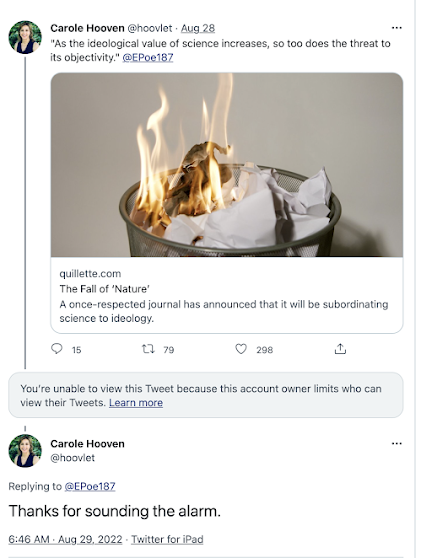
Carole Hooven was seen last August on Pinkerite, along with Larry Summers, when each was promoting Quillette's racist/neo-Nazi editor Bo Winegard last year.

It seems that Hooven's career is now supported by Steven Pinker. I'm not surprised.

Pinker is a long-time supporter and some-time contributor of racist rag Quillette, and an admirer of Bo Winegard.

Pinker is no doubt a supporter of Hooven because she's another believer in the sociobiology/evolutionary psychology school of gender and race essentialism, the "scientific" justification for right-wing bigotry.

In this article in the September 2022 edition of the Archives of Sexual Behavior,  Hooven defends Larry Summers' belief in the inferiority of lady brains in STEM.

In spite of Summers' claim, women's participation in STEM is steadily rising. 

We know that's not due to women's genetics or brain structure changing in such a short period of time. 

Maybe it's due to pushback against the essentialist beliefs that sociobiologists like Summers, Pinker, Winegard and Hooven cling to for dear life.

In the article, Hooven proposes the crackpot social affinity theory that is the absolute favorite sociobiologist explanation for why people are hostile to their pseudoscience-based claims. Bo Winegard is a big fan.

Hooven:
Why do people direct such outrage at scholars who are trying to do their jobs, discovering and communicating how the world works? In the aftermath of the Summers imbroglio, Steven Pinker, the well-known professor of psychology at Harvard, argued that Summers had been met with such vitriol because he had violated a cultural taboo. (Pinker 2005)  People who belong or want to belong to a social group, whether centered around political views, or a country or school, ethnic or gender identity, can signal their loyalty to the group and its values by demonstrating their "moral purity." (Paresky, 2022)

This fanciful explanation demonstrates how detached sociobiologists are from basic human social reality - maybe that's why they believe so reflexively that virtually all contemporary human behavior is the result of evolved biological essences.

The far more likely explanation for the Summers controversy is because at the time Summers made the statement he was the president of Harvard, speaking at a conference on why women were underrepresented in STEM, and Summers suggested the problem was women themselves.

To spell it out in a way that even a sociobiologist might grasp, Summers represented a clear institutional threat to women who were interested in STEM careers. How idiotic do you have to be to seriously believe the controversy was due to "moral purity"?

I would say that Hooven, Pinker, Paresky and Winegard are being deliberately obtuse, but I'm afraid it might not be deliberate. 

In this recent video, at minute 1:10 Hooven says:
...(Pinker's) also interested in, obviously, at lot of the kinds of issues that I'm interested in, The Blank Slate, is, you know, his early book, had a big impact on me and my thinking - how I thought about sex differences...

...more than anyone else at Harvard... he gave me a new office, he took me into his department, he stood up for me, he counseled me, it's been a really difficult time and he, if it weren't for him I really would not be at Harvard any more and I am because of him.... 


But Pinker has long been a champion of those who support sociobiology, as his ongoing support for hardcore race pseudoscience extremist Linda Gottfredson demonstrates.


"The Blank Slate" was Pinker's evolutionary psychology manifesto, so perfectly reviewed by Louis Menand in the New Yorker when it was released in 2002:
Having it both ways is an irritating feature of "The Blank Slate." Pinker can write, in refutation of the scarecrow theory of violent behavior, "The sad fact is that despite the repeated assurances that 'we know the conditions that breed violence,' we barely have a clue," and then, a few pages later, "It is not surprising, then, that when African American teenagers are taken out of underclass neighborhoods they are no more violent or delinquent than white teenagers." Well, that should give us one clue. He sums the matter up: "With violence, as with so many other concerns, human nature is the problem, but human nature is also the solution." This is just another way of saying that it is in human nature to socialize and to be socialized, which is, pragmatically, exactly the view of the "intellectuals." 
My theory for why Pinker tries to "have it both ways" is because he wants plausible deniability for his actual beliefs about Black people.

The New Yorker review mentions Judith Rich Harris, but the review does not mention how instrumental Pinker was in promoting the career of Harris. 
Moreover, when her great encourager Steven Pinker and I each nominated her paper for the annual award for “outstanding paper on general psychology,” the judges selected her as co-recipient of the—I am not making this up—George A. Miller Award. (To his credit, Miller later termed the irony “delicious.”)
Harris is so popular among believers in sociobiology that a leading promoter of "biosocial criminology," Kevin Beaver, is the Judith Rich Harris Professor of Criminology at Florida State University.


Biosocial Criminology holds that Black people are innately less intelligent, and more criminally-inclined than members of other "races." We know this because there is a book edited by Kevin Beaver, Biosocial Criminology: New Directions in Theory and Research in which his fellow biosocial criminologist John Paul Wright is given a chapter to argue that belief:

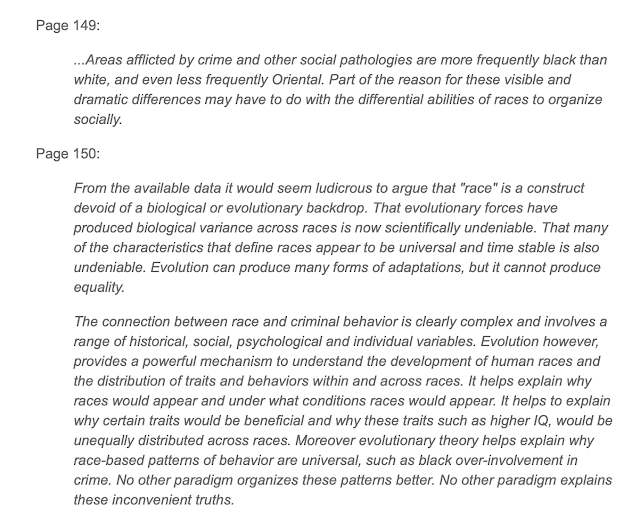
Page 149:
...Areas afflicted by crime and other social pathologies are more frequently black than white, and even less frequently Oriental. Part of the reason for these visible and dramatic differences may have to do with the differential abilities of races to organize socially. 
Page 150:
From the available data it would seem ludicrous to argue that "race" is a construct devoid of a biological or evolutionary backdrop. That evolutionary forces have produced biological variance across races is now scientifically undeniable. That many of the characteristics that define races appear to be universal and time stable is also undeniable. Evolution can produce many forms of adaptations, but it cannot produce equality. 
The connection between race and criminal behavior is clearly complex and involves a range of historical, social, psychological and individual variables. Evolution however, provides a powerful mechanism to understand the development of human races and the distribution of traits and behaviors within and across races. It helps explain why races would appear and under what conditions races would appear. It helps to explain why certain traits would be beneficial and why these traits such as higher IQ, would be unequally distributed across races. Moreover evolutionary theory helps explain why race-based patterns of behavior are universal, such as black over-involvement in crime. No other paradigm organizes these patterns better. No other paradigm explains these inconvenient truths.
I have no doubt Pinker holds similar beliefs. He has consistently promoted and supported those who hold these beliefs (Razib Khan, Bo Winegard, Linda Gottfredson, Steve Sailer) and his beliefs echo those of racist Amy Wax.

Unfortunately any time Pinker is interviewed, the interviewer treats him with kid gloves, due to the rarely broken gentlemen's agreement and refuses to make Pinker express exactly what he believes, as in this interview:
The left was uh completely out to lunch when it came to... the um causes of crime, badly badly wrong when it uh - it still does... when it attributes crime to um poverty and racism...
So if the problem isn't poverty and racism... what exactly is the problem? Pinker is too much the weasel to come right out and say it.

Pinker's influence extends to the promotion and support of the much debunked claims of the hypothesis called "Natural History of Ashkenazi Intelligence" created by two racists, who were brought together by racist Steve Sailer.

The publisher of the Hooven video, Freedom Pact likes to platform members and friends of the IDW including Bret Weinstein, Heather Heying, Niall Ferguson, Chloe Valdary, Dave Rubin, Douglas Murray and David Buss. 

The Freedom Pact website reveals nothing about who is funding them, but given how IDW-leaning its guests have become since 2018, including two interviews with Ivermectin-promoting Bret Weinstein, the brother of Peter Thiel's employee and apparent crackpot, Eric Weinstein, and given Thiel's reported financial support for race pseudoscience-promoting and IDW-connected Quillette, I have my suspicions.

And I predict that one day Carole Kennedy Hooven will have her own Quillette byline, where she can share her grievances with Quillette's far-right, racist and mostly male readership.

If Quillette will support Amy Wax's right to be a public racist troll while working for an educational institution, they'll certainly support Hooven. 

Saturday, December 11, 2021

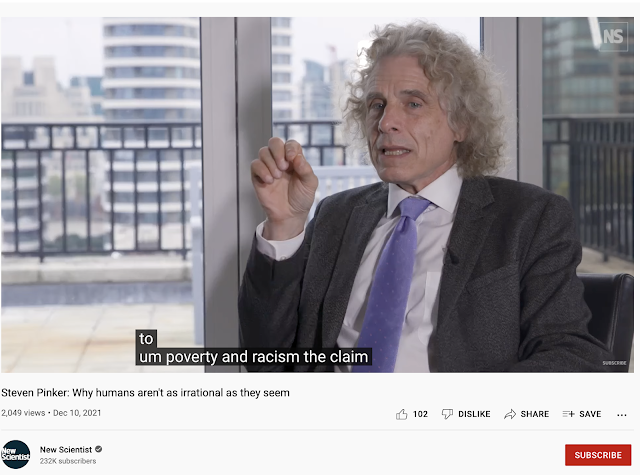
Pinker: the left is "out to lunch" to attribute crime to poverty and racism


During a mercifully brief interview with Graham Lawton of New Scientist, Steven Pinker, the world's most annoying man, compared the belief that crime is caused by poverty and racism to climate change denial.
...scientists are often surprised that there is so much denial... and it is sometimes attributed to scientific uh ignorance or scientific illiteracy... as it turns out itself a uh less than rational belief because it's not based on empirical studies of why people deny climate change... and what those studies show is that the deniers are actually no more ignorant of science than the believers, in fact a lot of people who endorse the scientific consensus are really uh out to lunch when it comes to the science of climate change, they think it has something to do with the ozone hole and toxic waste dumps plastic straws in the ocean. 

What does predict people's belief in climate change is just their politics the farther you are to the right the more denial there is.

Now that's a case in which the scientifically respectable conclusion is aligned with the left but there are also cases that go the other way, where it's the the uh the left that's out of touch with the scientific facts. 
The left was uh completely out to lunch when it came to... the um causes of crime, badly badly wrong when it uh - it still does... when it attributes crime to um poverty and racism...


But since the media almost always treats Pinker's utterances as unquestionable pearls of scientific wisdom, Lawton did not ask Pinker what he thinks is the true cause of crime.

I looked around for other instances of Pinker discussing crime, and found a Pinker interview from May with his fellow Quillette author Coleman Hughes. While Hughes is a Black American, he is also an apologist for race pseudoscience and a Koch employee, via the Koch-funded City Journal, and I wondered if Pinker was going to go all-in on a race pseudoscience explanation for crime.

Instead what I found was Pinker said something different about racism and crime:

HUGHES

...But I want to ask now a deep and basic question relating to human nature and a kind of fundamental disagreement on what human nature is and how that relates to violence. And and the question, which is deceptively simple, is: "What is the cause of crime? What causes people to commit crime? Does the question make sense? If so, why or why not?" And just how do you view that--because and the context is, most people I talk to about this issue take it for granted that crime is, you know, we know the causes of crime--poverty, inequality, systemic bias, hopelessness, despair. And I have no doubt that that is true in some cases, but I - I - I've been persuaded by by by many arguments that sort of hold that human nature can can kind of just tend towards this to begin with. 

So, where do you stand on that? And how do you, how do you think of that? 

PINKER

Yeah, there are ah, there different kinds of crime and there are different people who commit them out of different motives. Generally, it's certainly true that a lot of crime occurs in poor neighborhoods. And poor people are more likely to commit violent crime. It's not true, necessarily true of violence in general, especially through history when it used to be the aristocrats that had their armed retinues and would engage in contests of honor and revenge, dueling men men of honor as in the opening scene of Romeo and Juliet when two aristocratic families have a a street fight. 

So it's, that's not a given, but it tends to be true now. In general it's--although there are many causes of crime--they're not all racism and inequality, the ah especially not when it comes to changes over time.


So apparently Pinker does think that racism and poverty are causes of crime, just not the only ones. 

It would appear that in May 2021, Steven Pinker did not believe "leftists" were incorrect to the point of climate-change-denial-incorrectness. But in December 2021 he did.

Did Steven Pinker change his mind between the May and December? Or is this yet one more example of weak and strong pinkerism? 

Did Pinker change his response based on his audience, the way Pinker's buddy Razib Khan did on the issue of "white supremacy"?

Pinker's interview with Hughes demonstrates Pinker's utter obtuseness - it must be based on his own political leanings - when it comes to data:
PINKER 
...The great American crime decline, which began in 1992, which saw rates of violent crime plunge to half their levels in you know, in New York it plunged 75 percent. This was during a period of rising inequality. And even though there've been there was a slight deep systemic decrease in racism--not enough to have brought crime rates down that quickly, 50 percent in eight years...

We saw in "Better Angels" that Pinker attributed Black American high crime rates to low Black marriage rates. In spite of the data showing the opposite - marriage rates fell along with crime rates.

Pinker doesn't say what metric he is using to determine "inequality" here. But we do have one useful metric, which involves looking at data, so maybe that explains why Pinker missed it: 


And Black unemployment rates, while historically higher than white unemployment, also fell at the same time.


Seriously, what is wrong with Steven Pinker? Is he incapable of the tiniest effort to find data?

I'm not the first to be baffled by Steven Pinker. Way back nineteen years now, Louis Menand wrote the perfect Pinker review and said:

...Having it both ways is an irritating feature of "The Blank Slate." Pinker can write, in refutation of the scarecrow theory of violent behavior, "The sad fact is that despite the repeated assurances that 'we know the conditions that breed violence,' we barely have a clue," and then, a few pages later, "It is not surprising, then, that when African American teenagers are taken out of underclass neighborhoods they are no more violent or delinquent than white teenagers." Well, that should give us one clue...

The paragraph captures the "having it both ways" phenomenon seen repeatedly in Pinker's public opinions.

In the Hughes interview, right after Pinker claimed, without evidence, that inequality rose after 1992, he said this:

And even though there've been there was a slight deep systemic decrease in racism--not enough to have brought crime rates down that quickly, 50 percent in eight years--a lot of crime is opportunistic. People, there's a strong correlation between people who commit crime and lack of self-control.

Now "self-control" is a favorite subject of the biosocial criminologists, and they believe Black people possess less of it. As the reliably blunt rightwing biosocial criminologist John Paul Wright wrote:
While self-control is an important executive function, so, too, is intelligence. Indeed, there is no other individual variable as studied as intelligence. While hotly debated, thousands of studies of millions of individual intelligence scores indicate that IQ follows traditional racial categories (Rushton & Jenson, 2005). Asians have an average IQ of 106, Caucasians 100, and Blacks 85 (Lynn, 2006; Sarich & Miele, 2004)…

...Self-control and IQ covary, so that individuals with low self-control are also more likely to have low IQ. These deficits are potent enough to predict many of the negative life-course factors that afflicted individuals will experience. Longitudinal analyses of cohorts of individuals demonstrate that these individuals will face multiple problems across their life- course and that their self-limiting choices will show a high degree of continuity. Most will fail at their education and will then encounter problems in employment… They likely will live a fluid existence, relocating from place to place but often within the same economic stratum (Wright & decker, 1997). Finally their relationships will frequently be marred by conflict, unfaithfulness and unreliability. This pattern holds for anyone with deficits in executive control functions, black, white or Asian, but due to the distribution of low IQ and low self- control found in black populations, it is more often reflected in the lives of blacks.

And

Those passages were published in "Biosocial Criminology: New Directions in Theory and Research" edited by Anthony Walsh and Kevin Beaver.

I was aware that Steven Pinker promoted Brian Boutwell, a biosocial criminologist, but I wasn't aware how connected Pinker was to biosocial criminology until recently. I will be discussing that soon.

Tuesday, April 2, 2019

I Have a Nightmare: Steven Pinker, Quillette and the "biological reality of race"

Pinker links to the Winegards' 
"A Tale of Two Bell Curves"

When Sam Harris and Ezra Klein clashed over Harris's support for Charles Murray, Harris posted their exchange on his blog.

Harris begins:
In April of 2017, I published a podcast with Charles Murray, coauthor of the controversial (and endlessly misrepresented) book The Bell Curve. These are the most provocative claims in the book:
  1. Human “general intelligence” is a scientifically valid concept.
  2. IQ tests do a pretty good job of measuring it.
  3. A person’s IQ is highly predictive of his/her success in life.
  4. Mean IQ differs across populations (blacks < whites < Asians).
  5. It isn’t known to what degree differences in IQ are genetically determined, but it seems safe to say that genes play a role (and also safe to say that environment does too).
At the time Murray wrote The Bell Curve, these claims were not scientifically controversial—though taken together, they proved devastating to his reputation among nonscientists. 
In fact The Bell Curve was scientifically controversial from the beginning.

It should also be noted that Charles Murray isn't a life scientist but a political scientist. His co-author Richard Herrnstein was a psychologist who died in 1994.

The Bell Curve was known for getting some of its studies from people supported by the white supremacist Pioneer Fund.

In the text of the debate that Harris posted there is this:
(Harris)
The thing that is “very off” is the highly moralistic/tribal posture some people take on every topic under the sun, which makes rational conversation on important issues nearly impossible. If we do a podcast, that should be the central topic of conversation.
(Klein)
My working theory is that there’s a strong version and a weak version of Murrayism, both are represented in the conversation, but though the strong version is emphasized in the presentation, there’s been a retreat to the weak version upon challenge. But perhaps that’s wrong.
(Harris)
Actually, there is a real version and a fictional one. Here’s an article on that:

http://quillette.com/2017/03/27/a-tale-of-two-bell-curves/
Harris defends his take on The Bell Cuve by linking to an article in Quillette by brothers Ben Winegard and Bo Winegard called "A Tale of Two Bell Curves."

The Winegards' support for race science is clear when they write (highlights mine):
Of course, there are other possible explanations of the Black-White gap, such as parenting styles, stereotype threat, and a legacy of slavery/discrimination among others. However, to date, none of these putative causal variables has been shown to have a significant effect on the IQ gap, and no researcher has yet made a compelling case that environmental variables can explain the gap. This is certainly not for lack of effort; for good reason, scholars are highly motivated to ascertain possible environmental causes of the gap and have tried for many years to do just that.
You can build a case for "the legacy of slavery/discrimination" having an impact on intelligence in five minutes if you possess deductive reasoning ability and have access to the Internet.

Does poverty have an impact on intelligence? Yes.

Science Magazine: Poverty Impedes Cognitive Function

Have African Americans in general been poor since the days of slavery? Yes.

ScienceDirect: Slavery, education, and inequality
Abstract: We investigate the effect of slavery on the current level of income inequality across US counties. We find that a larger proportion of slaves over population in 1860 persistently increases inequality, and in particular inequality across races. We also show that a crucial channel of transmission from slavery to racial inequality is human capital accumulation, i.e., current inequality is primarily influenced by slavery through the unequal educational attainment of blacks and whites. Finally, we provide suggestive evidence that the underlying links run through the political exclusion of former slaves and the resulting negative influence on the local provision of education.
So there you have it - black people have been poorer than whites since the days of slavery and not only does the legacy of slavery impact the acquisition of wealth by blacks, an important related issue is unequal education attainment. Poor education leading to poverty and the stresses of poverty itself combine to provide a compelling case that blacks having lower test scores than whites is not genetic.

I wasn't aware of either of the two studies until I made a tiny effort to look. Did the Winegard brothers bother to look for such studies?

But the issue isn't only the Winegards' certainty that the Black-White test gap is biological and not the result of centuries of brutality and discrimination. As certain as they are of biological explanations for why one race is smarter than the other, they are just as equally uncertain which races exist. They explain their approach to racial classification in an article with coauthor "biosocial criminologist" Brian Boutwell, called On the Reality of Race and the Abhorrence of Racism (highlights are mine):
Race, then, is not a platonic essence and racial groups are not discrete categories of humans. Instead, race is a pragmatic construct that picks out real variation in the world (which corresponds to shared ancestry) and allows people and scientists to make useful inferences. In this way, racial categories are like film categories (e.g., drama, horror, comedy). Film categories are certainly real in the sense that they offer predictive power. If one knows that A Nightmare on Elm Street is a horror film, one can be reasonably certain that it will be dark, scary, and violent. But film categories are not immutable essences that perfectly sort movies into distinct types. A genre-based satire like Scream, for example, does not snugly fit into any of the traditional film categories. It might be horror; it might be comedy; it might be some previously unknown combination of the two. Furthermore, there aren’t a fixed number of film categories. The amount and the granularity of film categories depend upon the interests of the people using them. Your friend might use four (horror, comedy, drama, and science fiction), whereas Netflix might use an apparently limitless and startlingly specific supply. (See Daniel Dennett’s book for a variety of points and related examples centering on the topic of species). 
The same principles apply to racial categories. If one knows that Thomas is a Caucasian, one can be reasonably sure that Thomas has relatively light skin, and that he has recent ancestry in Europe.  But racial categories, like film categories, aren’t immutable essences that perfectly sort humans into distinct groups. There aren’t a fixed number of racial categories, and the number researchers use is partially a matter of convenience. One might start with five continentally based categories (i.e., Caucasians, East Asians, Africans, Native Americans, and Australian Aborigines) and then add more categories as one’s analysis becomes more granular (e.g. Ashkenazi Jewish, Mizrahi Jewish, and so on). These categories aren’t real in some metaphysical sense, but they are useful, and they do have predictive value.  In this, they are like many other constructs in the social sciences such as self-esteem, intelligence, and agreeableness. They represent traits that cluster together; they predict outcomes; and they can be quantified.
The Winegards and Boutwell not only don't know which races exist in any biologically-justifiable way, they feel this is the non-platonic-essence ideal: race classification should be like film categories - your friend might use one proprietary system, Netflix might use another and "one might" start with five sweeping categories and then choose "granular" categories which, if you are in the mood, you can call "race."

There's a likelihood the Winegards & Boutwell got the term platonic essence from Steve Sailer, who has been using the term since at least 1997. Pinker promoted the career of Sailer by including his piece on why Iraqis are too in-bred for democracy in the Pinker-edited edition of  "The Best American Science and Nature Writing" 2004. Sailer was described by Malcolm Gladwell, in an exchange with Steven Pinker as "a California blogger with a marketing background who is best known for his belief that black people are intellectually inferior to white people." (Gladwell's mother is Jamaican.)

Steven Pinker liked the Winegard/Boutwell article so much he linked to it from his Twitter account. 

Jerry Coyne linked to the Winegard/Boutwell piece from his blog, saying:
I’ve explained my take on “race” many times before, and you can search for it on this site. (If you want just one article, go here, which summarizes and glosses a like-minded piece from Quillette by Bo Winegard, Ben Winegard, and Brian Boutwell).
White supremacist American Renaissance liked it too, and reprinted it.

Pinker can be heard in this video saying that to deny the biological reality of race is to deny reality itself. Meanwhile he supports an article that goes one step beyond claiming race is a social phenomenon and instead claims race is a personal phenomenon, a group of classifications each individual can create for themselves based on convenience and expediency, subjective and completely unconcerned about issues of empiricism or even shared benchmarks with fellow race science proponents.

Race science proponents believe in the reality of race enough to classify "black" people as less intelligent than "white" people, while allowing the classification of race itself to be determined by personal taste. How is that not a recipe for bigots skewing studies of race and intelligence any way they wish?

Quillette is always howling about "postmodernism" just as Steven Pinker does, but how is this choose-your-own-race-categories based on whim any different from the most dastardly postmodernist's refusal to accept objective definitions?
It's important to note that, as far as I have found, there is no effort in studies of race and intelligence to use DNA testing to determine the ancestry of subjects. I asked Kevin Beaver, another biosocial criminologist (who appeared on white supremacist Stefan Molyneux's Youtube channel, twice) and sometime co-author with Boutwell, via email, how race determination was made in the studies he has used. He wrote back:
In all of my research, I have analyzed secondary data which has only included self-identification of race/ethnicity. As a result, I was never able to examine ancestry based on genetic testing.
Beaver is currently the Judith Rich Harris Professor of Criminology and Director, Distance Learning Program at Florida State University.

The recent popularity of consumer DNA testing has shown that very often individuals have no idea what their genetic ancestry is, making self-identification useless and making claims of race attributes based on self-identification absurd, at best.

Brian Boutwell has also appeared on white supremacist Stefan Molyneux's Youtube channel promoting race science.

Brian Boutwell will not say which races exist but you can be certain that Stefan Molyneux will. I have never found Beaver nor Boutwell - or for that matter Steven Pinker - disavowing Molyneux's identification and intelligence-ranking of  races which he can be seen doing  with race science proponent and Pioneer Fund financial award recipient Linda Gottfredson. For your convenience here is the races with rankings determined by Molyneux and Gottfredson:
  1. Ashkenazi Jews 
  2. Asians 
  3. Caucasians 
  4. Hispanic 
  5. African-Americans 
  6. Africans (Gottfredson's addition)

In spite of appearing on Molyneux's channel, Beaver and Boutwell are fairly careful about directly expressing biosocial criminology beliefs, but biosocial criminologist John Paul Wright, Professor of Criminal Justice at the University of Cincinnati, also an author in Quillette and a guest of Stefan Molyneux is more blunt. In the chapter "Inconvenient Truths" in the "Biosocial Criminology: New Directions in Theory and Research" edited by Beaver and Anthony Walsh and published in 2008, Wright says:

Page 149:

...Areas afflicted by crime and other social pathologies are more frequently black than white, and even less frequently Oriental. Part of the reason for these visible and dramatic differences may have to do with the differential abilities of races to organize socially.

Page 150:

From the available data it would seem ludicrous to argue that "race" is a construct devoid of a biological or evolutionary backdrop. That evolutionary forces have produced biological variance across races is now scientifically undeniable. That many of the characteristics that define races appear to be universal and time stable is also undeniable. Evolution can produce many forms of adaptations, but it cannot produce equality.

The connection between race and criminal behavior is clearly complex and involves a range of historical, social, psychological and individual variables. Evolution however, provides a powerful mechanism to understand the development of human races and the distribution of traits and behaviors within and across races. It helps explain why races would appear and under what conditions races would appear. It helps to explain why certain traits would be beneficial and why these traits such as higher IQ, would be unequally distributed across races. Moreover evolutionary theory helps explain why race-based patterns of behavior are universal, such as black over-involvement in crime. No other paradigm organizes these patterns better. No other paradigm explains these inconvenient truths.
In his Quillette article "Getting Voxed: Charles Murray, Ideology, and the Debate on IQ"  Boutwell writes:
The reality of racial variation cannot be hidden behind a veil of pleasant myths in perpetuity. And if researchers and moralists insist upon a noble lie about human genetic sameness, then they will not be prepared to grapple with the difficult ethical challenges that human variation in a cosmopolitan society presents. 

The "Reality of Race" article argues that the social construct of race, stated as: "Most people believe that race exists" is actually pretty good. It's only those damn intellectuals who insist on clarity and objective categorization:
Most people believe that race exists. They believe that Denzel Washington is an African American, that George Clooney is a Caucasian, and that George Takei is an Asian.* Many intellectuals, however, contend that this belief results from an illusion as dangerous as it is compelling. 
Intellectuals deny biology, according to Pinker, because it interferes with their pet theories of mind and behavior. These are the Blank Slate (the belief that the mind is wholly shaped by the environment), the Noble Savage (the notion that people are born good but are corrupted by society), and the Ghost in the Machine (the idea that there is a nonbiological agent in our heads with the power to change our nature at will). The "intellectuals" in Pinker's book are social scientists, progressive educators, radical feminists, academic Marxists, liberal columnists, avant-garde arts types, government planners, and postmodernist relativists. The good guys are the cognitive scientists and ordinary folks, whose common sense, except when it has been damaged by listening to intellectuals, generally correlates with what cognitive science has discovered. I wish I could say that Pinker's view of the world of ideas is more nuanced than this.
If you expect something more convincing to support the claim that race is a biological reality than windy assertions and postmodernist classification schemes you will be someone who holds, per Harris, a "highly moralistic/tribal posture.

And Steven Pinker seems so concerned that morality will pollute the purity of science he attempts to minimize immorality for its sake as noted by the NYTimes review of Enlightenment Now: The Case for Reason, Science, Humanism and Progress:
In one particularly tortured passage, Pinker goes so far as to downplay the harm of the notorious Tuskegee syphilis study — which tracked syphilis in 600 African-American men, many of them poor sharecroppers, withholding information and proper treatment from them — on the grounds that the doctors “did not infect the participants, as many believe.” The study, a “one-time failure to prevent harm to a few dozen people” (as he breezily puts it) “may even have been defensible by the standards of the day.” 
Why do this? Why not simply state that the study is a ghastly stain on the history of medicine? Despite the occasional warning that progress is “hard-won” and “perfect order” isn’t “the natural state of affairs,” Pinker’s book is filled with such fulsome apologias, which inadvertently suggest that the gains of the Enlightenment are so delicate that they require the historical gloss he compulsively provides.
Is it a mere coincidence that Pinker minimizes injustice against African Americans? Well consider this from the Menand review of "The Blank Slate" 
Having it both ways is an irritating feature of "The Blank Slate." Pinker can write, in refutation of the scarecrow theory of violent behavior, "The sad fact is that despite the repeated assurances that 'we know the conditions that breed violence,' we barely have a clue," and then, a few pages later, "It is not surprising, then, that when African American teenagers are taken out of underclass neighborhoods they are no more violent or delinquent than white teenagers." Well, that should give us one clue. He sums the matter up: "With violence, as with so many other concerns, human nature is the problem, but human nature is also the solution." This is just another way of saying that it is in human nature to socialize and to be socialized, which is, pragmatically, exactly the view of the "intellectuals."
The homicide rate in New Orleans last year was forty-nine per hundred thousand, roughly what Amsterdam’s was six hundred years ago. St. Louis’s and Detroit’s murder rates in 2010 were about forty per hundred thousand, around the rate of London in the fourteenth century. (Detroit’s 2010 murder rate, it should be noted, actually represents a big improvement; in the late nineteen-eighties, it was more than sixty per hundred thousand.) 
Do these cities lag behind in “the civilizing process” because they’re poor or educationally disadvantaged? No, Pinker argues; the key factor is that they have large African-American populations. Low-income blacks in the U.S. are “effectively stateless,” living in a sort of Hobbesian dystopia beyond the reach of law enforcement. It doesn’t help that cities like New Orleans and St. Louis are in the South; according to Pinker, the entire region is several steps behind, as “the civilizing mission of government never penetrated the American South as deeply as it had the Northeast, to say nothing of Europe.” 
As Pinker’s views on African-Americans and Southerners probably indicate, there is much in “The Better Angels of Our Nature” that is confounding...
Pinker was not pleased with the Kolbert review and asked Razib Khan, a leading proponent of race science, to defend his work.

Pinker seems determined to deny the role that economics plays in the condition of post-Emancipation African-Americans. Just as the Winegards, in the Bell Curve article cited by Sam Harris claim that a legacy of slavery is insignificant.

It appears to me that race science proponents are attempting to make the case that genetics explain why African-Americans have failed to thrive in the United States, post-Emancipation by ignoring, minimizing or denying the role that economic conditions and injustice over time have played - and still play - in their lives.

And because the entire history of African-Americans right up to the present is full of grotesque injustice, the race science proponents are attempting to portray those who insist historical facts and current events are important as emotion-driven moralists.

In the Harris-Klein debate there is this exchange and Harris presents the dichotomy of scientific facts vs. historical injustice (highlights mine):

Ezra Klein
I doubt that we have, given the experiment we have run in this country, given the centuries of slavery and segregation and oppression, given locking people out of jobs, out of good schools, out of building wealth, out of going into top professions, out of being part of the social networks that help you advance; the amount of violence and terror and trauma that we have inflicted on African Americans in this country, I absolutely doubt — I truly, to the core of my being, doubt — that we are at a place where any of us should have confidence saying that the differences we see in individuals now reflect intrinsic group capacity. I think that at every other point in America history where we have said that —

Sam Harris
But even Murray wouldn’t say that.

Ezra Klein
That is exactly what Murray says. That at every other point in American history.

Sam Harris
Again, there is confusion creeping in here.

Ezra Klein
There is not confusion.

Sam Harris
Okay, I’ll try to sort it out in my next volley.


Ezra Klein
You’ll sort it out. Of course. At every point in American history where we have made that argument, we now look back — and, I mean, this is not going way back. Segregation, my mom was alive in segregation. Charles Murray was alive during segregation. We’re talking, I think, it’s within the week of the 50th anniversary of Martin Luther King’s assassination. This is not ancient history, it is recent history.

I think we look back and say, “Man, they really had it wrong.” You quoted back at me something that I think either I say it, or the Vox authors say it, now I don’t remember, but that, yeah, if you’re having a version of this conversation again, then it is incumbent on you to say why you’re so sure it will be different this time.

Murray does say he thinks that some combination of genetic and basically immutably environmental characteristics make it so we can’t do much about this and there just are big differences between the groups, and it’s just going to remain that way, and American politics need to rearrange itself around that reality.

Yeah, I strongly disagree, and I disagree because of American history. That is why my fundamental criticism of that conversation was that you needed to deal more with the history of this conversation and the history of this country.

Sam Harris
Okay, but even in this conversation you are unwilling to differentiate scientific fact and scientific data and reasonable extrapolations based on data, from past injustices in American history, these are totally separate things —

Ezra Klein
No, we disagree on what a reasonable extrapolation from the data is.


Brian Boutwell appears on Stefan Molyneux's channel in March 2017 and then his "Getting Voxed" article was published in Quillette in June 2017. In the article he attempts to distance himself from "bigoted people." He makes a reference to King's "I Have a Dream" speech in which King said:
I have a dream that my four little children will one day live in a nation where they will not be judged by the color of their skin, but by the content of their character. 
which Boutwell rephrases:
Of course, we understand that many people have legitimate concerns about studying race differences. It is true that bigoted people might use data about race and IQ to support nefarious political agendas, buttressing their own prejudices with scientific sounding arguments. However, the way to address this danger is not by distorting previous research or publicly attacking scholars who investigate this issue. Rather, it is by promoting the vision of society that Martin Luther King, Jr. advocated decades ago, one in which people are judged by their actions and the content of their characters and not by the average traits of a group (ethnic, political, religious, or otherwise). 
Brian Boutwell is either unaware of the irony, or perhaps is just that shameless, in hijacking the words of Martin Luther King, Jr.'s "I Have a Dream" speech to argue against "pleasant myths" and for "inconvenient truths" about the black "race" and its alleged lower intelligence and higher criminality.

In the absence of any empirical standards, how will "race" be determined? All that remains of the claims of the "biological reality" of race is a social construct, the average person's gut instinct of "race."
If one knows that Thomas is a Caucasian, one can be reasonably sure that Thomas has relatively light skin, and that he has recent ancestry in Europe.

RELATED POSTS


Sunday, November 18, 2018

Steven Pinker's right-wing, alt-right & hereditarian connections

The PDF version is available here.


Click the image to see a larger version.


The series on "evo-psycho bros."
https://mcclernan.blogspot.com/search/label/evo-psycho%20bros


  1. https://mcclernan.blogspot.com/search/label/evo-psycho%20bros

    What are hereditarians?

    Although right-wing and alt-right are fairly well-known terms, "hereditarian" is not and requires an explanation.

    "Hereditarian" - an advocate of the theory that individual differences in human beings can be accounted for primarily on the basis of genetics.


    Although in practice the term most often refers to racial differences, as discussed by Linda Gottfredson:
    Rushton and Jensen’s (2005) hereditarian hypothesis is that Black–White differences in general intelligence (IQ, or the general mental ability factor, g) are “substantially” genetic in origin...

    https://www1.udel.edu/educ/gottfredson/reprints/2005hereditarian-hypothesis.pdf

    Other terms which are similar are "evolutionary psychology," "human biodiversity" and "racial realism." Related to these terms is "biosocial criminology."

    Steven Pinker

    Steven Pinker is an experimental psychologist who conducts research in visual cognition, psycholinguistics, and social relations. He grew up in Montreal and earned his BA from McGill and his PhD from Harvard. Currently Johnstone Professor of Psychology at Harvard, he has also taught at Stanford and MIT. He has won numerous prizes for his research, his teaching, and his nine books, including The Language Instinct, How the Mind Works, The Blank Slate, The Better Angels of Our Nature, and The Sense of Style. He is an elected member of the National Academy of Sciences, a two-time Pulitzer Prize finalist, a Humanist of the Year, a recipient of nine honorary doctorates, and one of Foreign Policy’s “World’s Top 100 Public Intellectuals” and Time’s “100 Most Influential People in the World Today.” He is Chair of the Usage Panel of the American Heritage Dictionary, and writes frequently for The New York Times, The Guardian, and other publications. His tenth book, to be published in February 2018, is called Enlightenment Now: The Case for Reason, Science, Humanism, and Progress.

    https://stevenpinker.com/biocv

    The Blank Slate

    Written by Pinker, published in 2002, this is the New Testament to The Bell Curve's Old Testament for hereditarians.
    Although Steven Pinker claims in The Blank Slate that he doesn't agree with the conclusions about black intelligence made in The Bell Curve, he has never to my knowledge explained why, although he agrees with almost every other hereditarian claim, the Bell Curve is wrong about that.

    ...Intellectuals deny biology, according to Pinker, because it interferes with their pet theories of mind and behavior. These are the Blank Slate (the belief that the mind is wholly shaped by the environment), the Noble Savage (the notion that people are born good but are corrupted by society), and the Ghost in the Machine (the idea that there is a nonbiological agent in our heads with the power to change our nature at will). The "intellectuals" in Pinker's book are social scientists, progressive educators, radical feminists, academic Marxists, liberal columnists, avant-garde arts types, government planners, and postmodernist relativists. The good guys are the cognitive scientists and ordinary folks, whose common sense, except when it has been damaged by listening to intellectuals, generally correlates with what cognitive science has discovered. I wish I could say that Pinker's view of the world of ideas is more nuanced than this...


    Quillette


    Quillette is an online magazine founded by Australian writer and former psychology graduate student Claire Lehmann. The publication has a primary focus on science, news, culture, and politics... The magazine has been praised by the evolutionary biologist and writer Richard Dawkins, who described it as a "superb online magazine", and has garnered support by the psychologist Jordan Peterson.

    https://en.wikipedia.org/wiki/Quillette

    Steven Pinker has recommended Quillette articles on Twitter and said about Quillette:


    ...one of the most stimulating &amp; original new web magazines.

    https://twitter.com/sapinker/status/909489258918027264?lang=en

    Quillette has published many hereditarians, some of whom have been interviewed by Stefan Molyneux and republished articles in the white supremacist American

    Renaissance including Kevin M. Beaver, Brian Boutwell, Ben and Bo Winegard and John P. Wright.


    Claire Lehmann

    ...Australian writer and the editor and founder of the online magazine Quillette. Before starting Quillette, I was a grad-student in psychology, but dropped out after having a baby. I graduated from The University of Adelaide with First Class Honours in 2010. I’ve written for Quillette, Commentary Magazine, Psychology Today, The Sydney Morning Herald, ABC’s The Drum, and my essays have been cited in the National Review, The Wall Street Journal, The Australian, and The Spectator. I live in Sydney with my husband and two children.
    https://clairelehmann.net/bio/
    Until late 2017 Claire Lehmann was a contributor to Rebel Media.

    https://australia.therebel.media/claire_lehmann

    Kevin M. Beaver


    Quillette article

    http://quillette.com/2016/03/31/criminologys-wonderland-why-almost-everything-you-know- about-crime-is-wrong/

    Interviewed twice on Stefan Molyneux's channel

       Brian Boutwell


       Quillette articles

Steven Pinker tweeted to his followers links to Quillette articles by Boutwell

     Ben Winegard

     Quillette articles

Steven Pinker tweeted to his followers links to Quillette articles by Winegard.

     Bo Winegard

  • Bo Winegard is an essayist and a graduate student at Florida State University.

    https:// psy.fsu.edu/~baumeisterticelab/winegard.html

     Quillette articles

Steven Pinker tweeted to his followers links to Quillette articles by Winegard.


John Paul Wright

Professor, University of Cincinnati... He currently teaches Biosocial Criminology at the undergraduate level and Life-Course Criminology and Criminal Offender at the graduate level.


Quillette articles

At last count John Paul Wright has authored one article in Quillette


Interviewed on Stefan Molyneux's channel

https://www.youtube.com/watch?v=i2w23Zc-Zfs

Wright, Boutwell and Beaver are all academics who work in criminology, and have published articles and books together.


Of the three, John Paul Wright is the most openly political, publishing with co-author Matt DeLisi in 2015 "Conservative Criminology: A Call to Restore Balance in the Social Sciences" and an associated web site Conservative Criminology.
Wright is also the most candid about admitting the actual beliefs behind "biosocial criminology." In his chapter "Inconvenient Truths: Science, Race, and Crime" in the book "Biosocial Criminology: New Directions in Theory and Research" edited by Kevin M. Beaver and Anthony Walsh he wrote:

While self-control is an important executive function, so, too, is intelligence. Indeed, there is no other individual variable as studied as intelligence. While hotly debated, thousands of studies of millions of individual intelligence scores indicate that IQ follows traditional racial categories (Rushton &amp; Jenson, 2005). Asians have an average IQ of 106, Caucasians 100, and Blacks 85 (Lynn, 2006; Sarich &amp; Miele, 2004)…

...Self-control and IQ covary, so that individuals with low self-control are also more likely to have low IQ. These deficits are potent enough to predict many of the negative life-course factors that afflicted individuals will experience. Longitudinal analyses of cohorts of individuals demonstrate that these individuals will face multiple problems across their life- course and that their self-limiting choices will show a high degree of continuity. Most will fail at their education and will then encounter problems in employment… They likely will live a fluid existence, relocating from place to place but often within the same economic stratum (Wright &amp; decker, 1997). Finally their relationships will frequently be marred by conflict, unfaithfulness and unreliability. This pattern holds for anyone with deficits in executive control functions, black, white or Asian, but due to the distribution of low IQ and low self- control found in black populations, it is more often reflected in the lives of blacks.

https://www.amazon.com/Biosocial-Criminology-Directions-Research-Justice/dp/0415989442/ ref=sr_1_1?ie=UTF8&amp;qid=1520285963&amp;sr=8-1&amp;keywords=Biosocial+Criminology%3A+New
+Directions+in+Theory+and+Research

Although I haven't found Beaver or Boutwell writing anything this frank, they also have never, as far as I can tell, had a problem with Wright's claims and Beaver was the editor of the book in which the above excerpt appeared. It's clear Brian Boutwell and Kevin M. Beaver agree with everything John Paul Wright says on this subject.

Rebel Media

The Rebel Media... is a Canadian far-right online political and social commentary media website founded in February 2015 by the former Sun News Network host Ezra Levant, Brian Lilley, and Hamish Marshall... Gavin McInnes, founder of the Proud Boys far-right men's organization, is also a contributor.

https://en.wikipedia.org/wiki/The_Rebel_Media

Until late 2017 Claire Lehmann was a contributor to Rebel Media.
https://australia.therebel.media/claire_lehmann

Gavin McInnes

McInnes himself has ties to the racist right and has contributed to hate sites like VDare.com and American Renaissance, both of which publish the work of white supremacists and so- called “race realists.”

https://www.splcenter.org/fighting-hate/extremist-files/group/proud-boys 

McInnes has been a frequent contributor to Rebel Media.

https://www.youtube.com/channel/UCGy6uV7yqGWDeUWTZzT3ZEg/search? query=mcinnes

McInnes declared Steven Pinker to be one of his heroes in Taki's Magazine. 

http://takimag.com/article/a_deadly_strain_of_pms_gavin_mcinnes/print#axzz4RjUDE8ZZ

McInnes appeared on InfoWars.

 https://www.youtube.com/watch?v=10n_dbFEAbQ

Taki's Magazine

Founded on February 5, 2007, the intent of the site, according to Theodoracopulos, was to "shake up the stodgy world of so-called 'conservative' opinion..." "Takimag is a Libertarian webzine. We believe the best stories are smart, cheeky, and culturally relevant. We take our politics like we take life—lightly.".[4] The website garnered some controversy in 2013 after it published articles in support of the Greek ultranationalist political party Golden Dawn.[5][6] [7]

https://en.wikipedia.org/wiki/Taki%27s_Magazine

Gavin McInnes, Razib Khan, Richard Spencer, Steve Sailer, and Jared Taylor have all contributed to Taki's.


Stefan Molyneux

A skilled propagandist and an effective communicator within the racist “alt-right” and pro- Trump ranks, his promotion of scientific racism and eugenics to a large and growing audience is a serious concern. Molyneux has been delivering “race realist” propaganda, based on pseudo-scientific sources, to his audience on an ongoing basis for over two years, and thus has encouraged thousands of people to adopt his belief in biological determinism, social Darwinism and non-white racial inferiority. Molyneux puts considerable effort into cloaking the practical implications of these beliefs across his media platforms.


Molyneux interviewed Ezra Levant, founder of Rebel Media. https://www.youtube.com/watch?v=P8Kj-R4Ja08&amp;t=140s
Molyneux also appeared on InfoWars.


In addition to interviews with authors from Quillette, Molyneux has interviewed an assortment of hereditarians on his channel which he has gathered together under the heading Human Intelligence (IQ) | The Experts Interview Series. Those interviewed include Charles Murray, Richard Lynn and Linda Gottfredson.

https://www.youtube.com/watch? v=6lsa_97KIlc&amp;list=PLMNj_r5bccUyYzJ5G1GgvfM59JEpDkteX

InfoWars

InfoWars is an American conspiracy theorist website and media platform owned by Alex Jones's Free Speech Systems LLC.[2][3][4][5][6] It was founded in 1999.Talk shows and other content is created primarily in studios at an undisclosed location in an industrial area outside Austin, Texas.[7] The InfoWars website receives approximately 10 million monthly visits, making it more visited than some mainstream news websites such as The Economist and Newsweek.[8][9]The site has regularly published fake stories which have been linked to harassment of victims.[a] In February 2018, Alex Jones, the publisher, director and owner of InfoWars, was accused of discrimination and sexually harassing employees.[16] InfoWars, and in particular Alex Jones, advocate numerous conspiracy theories particularly around purported domestic false flag operations by the US Government (which they allege include the 9/11 attacks and Sandy Hook shootings). InfoWars has issued contractions various times as a result of legal challenges.

https://en.wikipedia.org/wiki/InfoWars

Gavin McInnes and Stefan Molyneux have both appeared on InfoWars.


David Duke

David Duke is the most recognizable figure of the American radical right, a neo-Nazi, longtime Klan leader and now international spokesman for Holocaust denial who has nevertheless won election to Louisiana's House of Representatives and once was nearly elected governor.Duke... endorsed Molyneux’s propaganda multiple times on social media over the last few years, most notably in his promotion of Molyneux’s apologia for George Zimmerman, known for the fatal shooting of Trayvon Martin.


Razib Khan

On March 18, 2015, The New York Times announced that Razib Khan would become a contributing opinion writer. A day later, The Times terminated the contract.At the time, Khan was a Ph.D. student in genetics at the University of California, Davis and a popular science blogger. He had written about science for The Times, Slate, The Guardian, and other mainstream publications. For years, Discover had hosted his genetics blog. The famed Harvard psychologist Steven Pinker had even called him “an insightful commentator on all
things genetic...”...Still, Khan insisted that his writing about the biology of race was sound. “It’s not socially acceptable to say that there might be group differences in an endophenotype — in their behavior, intelligence, anything that might have any genetic component,” Khan said. “You cannot say that, okay? If someone’s going to ask me, I’m going say, ‘It could be true.’”Other scientists, he insisted, believe the same things. They just won’t admit it. “I’m sick of being the only fucking person that says anything,” said Khan. “I know I make people uncomfortable, but a lot of times I say what they’re thinking...”

https://undark.org/article/race-science-razib-khan-racism/

From Steven Pinker's web site

But aren’t you just being defensive? Authors always think that negative reviews of their book are wrong. Has anyone else replied to Kolbert? Razib Khan has a response in the Gene Expression blog on the Discover magazine Web site: 

http://blogs.discovermagazine.com/ gnxp/2011/10/relative-angels-and-absolute-demons/https://stevenpinker.com/pages/ frequently-asked-questions-about-better-angels-our-nature-why-violence-has-declined

Razib Khan had a regular column at Unz Review. 

http://www.unz.com/author/razib-khan/

Khan has frequently contributed to Taki's Magazine. 

http://takimag.com/contributor/razibkhan/130#axzz58vAMiv94

Khan published an article with co-author Brian Boutwell in Quillette. 

http://quillette.com/2016/01/19/heritability-and-why-parents-but-not-parenting-matter/

The Unz Review

Razib Khan, who lost an opportunity at the New York Times over his views on human biodiversity, now writes for the alt-right Unz Review.

http://www.breitbart.com/tech/2016/03/29/an-establishment-conservatives-guide-to-the-alt- right/

Steve Sailer

Sailer is the founder of the Human Biodiversity Institute, a neo-eugenics online discussion forum where right-wing journalists and race scientists have promoted selective breeding of the human species. He also writes frequently for the anti-immigrant hate site Vdare.com...

https://www.splcenter.org/hatewatch/2008/07/25/extremist-steve-sailer-source-cnns-black- america-series

Steve Sailer author at American Renaissance article list.

https://www.amren.com/author/steve-sailer/


Steve Sailer article list at Taki's Magazine. 

http://takimag.com/contributor/Sailer/6#axzz58fTkpD9r

Steve Sailer article list at Unz Review. 

http://www.unz.com/isteve/

The Best American Science and Nature Writing 2004

In 2004 an article by Steve Sailer, "The Cousin Marriage Conundrum" was included in "The Best American Science and Nature Writing."

https://www.amazon.com/Best-American-Science-Nature-Writing/dp/0618246975/ ref=tmm_hrd_swatch_0?_encoding=UTF8&amp;qid=&amp;sr=

Steven Pinker edited the book along with Tim Folger. Folger responded to my email query about Sailer's inclusion:


In hindsight Sailer's story shouldn't have been included in the anthology, and we should have looked into his background more carefully. Until reading your email today, I knew nothing about Sailer's alt-right connections. Steven Pinker selected the story, and unfortunately I never discussed the article with him, an oversight that I regret.
My review of Sailer's "The Cousin Marriage Conundrum" here: https://mcclernan.blogspot.com/2018/02/steve-sailer-in-best-american-science.html

Steven Pinker &amp; Malcolm Gladwell

I wondered about the basis of Pinker’s conclusion, so I e-mailed him, asking if he could tell me where to find the scientific data that would set me straight. He very graciously wrote me back. He had three sources, he said. The first was Steve Sailer. Sailer, for the uninitiated, is a California blogger with a marketing background who is best known for his belief that black people are intellectually inferior to white people.


VDARE

VDARE also publishes essays by prominent academic racists. For example, a column by Jared Taylor, who has argued elsewhere that black people are incapable of maintaining any kind of civilization, dismisses "the fantasy of racial equality," claims the Civil Rights Act of 1964 "stripped Americans of the right to make free decisions," and says that "[b]lacks, in particular, riot with little provocation," unlike the far more peaceable white race. He has also published pieces by J. Philippe Rushton, the head of the Pioneer Fund, which gives financial backing to academics who specialize in race and IQ studies.

Jared Taylor

Taylor entered the active racist scene in 1990, when he founded the New Century Foundation, a pseudo-intellectual think tank that promotes "research" arguing for white superiority. A year later, he began publishing American Renaissance, a magazine that focuses on the alleged links between race and intelligence, and on eugenics, the now discredited "science" of breeding better humans.


Richard Spencer

...In 2007, after he dropped out of a Ph.D. program at Duke University in modern European intellectual history, Spencer took a job as assistant editor at American
Conservative magazine, where he was later fired for his radical views, according to former colleague J. Arthur Bloom. Following that, Spencer became executive editor of the paleoconservative website, Taki’s Magazine. In 2010, Spencer founded AlternativeRight, a supremacy-themed webzine aimed at the “intellectual right wing,” where he remained until joining NPI... In an address at white supremacist Jared Taylor’s 2013 American Renaissance conference, Spencer called for “peaceful ethnic cleansing.” As an example of how this could be accomplished, he cited the 1919 Paris Peace Conference, where new national boundaries were formed at the end of World War I. “Today, in the public imagination, ‘ethnic cleansing’ has been associated with civil war and mass murder (understandably so),” Spencer said. “But this need not be the case. 1919 is a real example of successful ethnic redistribution—done by fiat, we should remember, but done peacefully.”


American Renaissance

Founded by Jared Taylor in 1990, the New Century Foundation is a self-styled think tank that promotes pseudo-scientific studies and research that purport to show the inferiority of blacks to whites — although in hifalutin language that avoids open racial slurs and attempts to portray itself as serious scholarship. It is best known for its American Renaissance magazine and website, which regularly feature proponents of eugenics and blatant anti- black racists. The foundation also sponsors American Renaissance conferences every other year where racist "intellectuals" rub shoulders with Klansmen, neo-Nazis and other white supremacists.


Richard Lynn

Lynn is the current president of the notoriously racist Pioneer Fund. Prior to becoming president in 2012, he received hundreds of thousands of dollars in Pioneer Fund grants, both directly, and through the Ulster Institute for Social Research. Lynn is the founder and president of the Ulster Institute, “a think tank for the support of research on social issues and the publication of works by selected authors in this field.” According to its website, “The Ulster Institute for Social Research specialises in the application of psychology to the
analysis of social problems,” which translates to promoting racist research by Lynn and several of his colleagues and collaborators......He has contributed to several white supremacist publications including VDARE.com, The Occidental Quarterly, and American Renaissance. He also sits on the editorial committee of Mankind Quarterly, a pseudo- scholarly journal dedicated to publishing “articles in controversial areas, including behavioral group differences and the importance of mental ability for individual outcomes and group differences” — a thinly veiled admission that they primarily print racist pseudoscience.


Now, as race science leaches back into mainstream discourse, it has also been mainlined into the upper echelons of the US government through figures such as Bannon. The UK has not been spared this revival: the London Student newspaper recently exposed a semi- clandestine conference on intelligence and genetics held for the last three years at UCL without the university’s knowledge. One of the participants was the 88-year-old Ulster-based evolutionary psychologist Richard Lynn, who has described himself as a “scientific racist”.


Pioneer Fund

...Arthur Jensen, an educational psychologist focusing on race since 1966, got more than $1 million in Pioneer grants over three decades. In his famous 1969 attack on Head Start — the early-education program that aims to help poor children — Jensen wrote in the prestigious Harvard Education Review that the problem with black children was that they had an average IQ of only 85. No amount of social engineering could improve that performance, he claimed, adding that "eugenic foresight" was the only solution......In recent decades, the Pioneer Fund has supported mostly American and British race scientists, including a large number of those cited in The Bell Curve, a widely criticized 1994 book that claimed that differences in intelligence were at least partly determined by race. According to Barry Mehler, a leading academic critic of the fund, these race scientists have included Hans Eysenck, Robert A. Gordon, Linda Gottfredson, Seymour Itzkoff, Arthur Jensen, Michael Levin, Richard Lynn, R. Travis Osborne, J. Philippe Rushton, William Shockley and Daniel R. Vining Jr.


R. Philippe Rushton

From 2002 until his death, the Pioneer Fund was headed by Rushton, a Canadian professor who has been investigated for allegedly violating Canadian hate-speech laws. Rushton first courted controversy in 1989 when he published work focusing on the sexual characteristics of different races. His findings: blacks have larger genitals, breasts and buttocks — characteristics that Rushton alleges have an inverse relationship to brain size and, thus, intelligence. Rushton has personally received over $1 million in Pioneer funds to support his work.


Sam Harris

The “skeptics” movement — whose adherents claim to challenge beliefs both scientific and spiritual by questioning the evidence and reasoning that underpin them — has also helped channel people into the alt-right by way of “human biodiversity.” Sam Harris has been one of the movement’s most public faces, and four posters on the TRS thread note his influence.

Under the guise of scientific objectivity, Harris has presented deeply flawed data to perpetuate fear of Muslims and to argue that black people are genetically inferior to whites. In a 2017 podcast, for instance, he argued that opposition to Muslim immigrants in European nations was “perfectly rational” because “you are importing, by definition, some percentage, however small, of radicalized people.” He assured viewers, “This is not an expression of xenophobia; this is the implication of statistics.” More recently, he invited Charles Murray on his podcast. Their conversation centered on an idea that lies far outside of scientific consensus: that racial differences in IQ scores are genetically based. Though mainstream behavioral scientists have demonstrated that intelligence is less significantly affected by genetics than environment (demonstrated by research that shows the IQ gap between black and white Americans is closing, and that the average American IQ has risen dramatically since the mid-twentieth century), Harris still dismissed any criticism of Murray’s work as “politically correct moral panic.”

For posters on TRS, Harris’ work blended easily into that of more overtly racist writers like Paul Kersey, whose popular blog, “Stuff Black People Don’t Like,” is reposted on American Renaissance. The site “really gets the noggin joggin and encourages you to search for answers,” one user wrote. Their “biggest stepping stone” was from Harris’ work to Kersey’s blog: “It was there I learned about race realism, IQ, genetics, bell curves, and the economic/ political drivers behind the pushing of ‘diversity.’”

https://www.splcenter.org/20180419/mcinnes-molyneux-and-4chan-investigating-pathways-alt-right

Harris defended his views in his argument with Ezra Klein about the Murray podcast by providing a link to an article by Bo Winegard and Ben Winegard in Quillette, "A Tale of Two Bell Curves" which argues that The Bell Curve is correct about lower inherent black intelligence and in fact states that "no good alternative explanations" to the hereditarian position exist.

https://samharris.org/ezra-klein-editor-chief/

Quillette published an article in support of Harris. 

http://quillette.com/2018/04/12/sam-harris-right-ezra-klein-know-better/

Sam Harris is listed as a supporter of Quillette on Patreon. https://www.patreon.com/samharris

Harris and Pinker have a mutual admiration society as can be seen in this video.


And in tweets such as this.

https://twitter.com/sapinker/status/980178989544243201?lang=en

Charles Murray

Charles Murray has been a central figure in discussions of race, intelligence and public policy since the 1994 publication of The Bell Curve, which Murray co-authored with controversial psychologist Richard Herrnstein, who died shortly before the book’s publication. Murray, a statistically minded sociologist by training, has spent decades working to rehabilitate long-discredited theories of IQ and heredity, turning them into a foundation on which to build a conservative theory of society that rejects equality and egalitarianism.

“You want to have a job training program for welfare mothers? You think that’s going to cure the welfare problem? Well, when you construct that job training program and try to decide what jobs they might qualify for, you had better keep in mind that the mean IQ of welfare mothers is somewhere in the 80s, which means that you have certain limitations in what you're going to accomplish.”—Interview on race and IQ, “Think Tank with Ben Wattenberg,” PBS, 1994.

The year after The Bell Curve was published, in the lead-up to a Republican congress slashing benefits for poorer Americans, Murray gave expert testimony before a Senate committee on welfare reform; more recently, congressman Paul Ryan, who helped push the Republicans’ latest tax cuts for the wealthy, has claimed Murray as an expert on poverty.


One of the reasons scientific racism hasn’t gone away is that the public hears more about the racism than it does about the science. This has left an opening for people such as Murray and Wade, in conjunction with their media boosters, to hold themselves up as humble defenders of rational enquiry.


The Bell Curve

For all the shock value of its assertion that blacks are intractably, and probably biologically, inferior in intelligence to whites and Asians, The Bell Curve is not quite an original piece of research. It is, in spite of all the controversy that is attending its publication, only a review of the literature—an elaborate interpretation of data culled from the work of other social scientists. For this reason, the credibility of its authors, Charles Murray and Richard J. Herrnstein, rests significantly on the credibility of their sources...

Surely the most curious of the sources he and Herrnstein consulted is Mankind Quarterly—a journal of anthropology founded in Edinburgh in 1960. Five articles from the journal are actually cited in The Bell Curve’s bibliography (pp. 775, 807, and 828).2
But the influence on the book of scholars linked to Mankind Quarterly is more significant. No fewer than seventeen researchers cited in the bibliography of The Bell Curve have contributed to Mankind Quarterly. Ten are present or former editors, or members of its editorial advisory board. This is interesting because Mankind Quarterly is a notorious journal of “racial history” founded, and funded, by men who believe in the genetic superiority of the white race.3......

They cite in their book no fewer than thirteen scholars who have benefited from Pioneer Fund grants in the last two decades—the grants total more than $4 million. Many of The Bell Curve’s sources who worked for Mankind Quarterly were also granted Pioneer money.16...

There is no way to isolate the scholarship of Richard Lynn, and that of the other Mankind Quarterly contributors, from their racial and political views. Social science is not so easily insulated from ideology, as Murray and Herrnstein are quick to emphasize when railing against their critics. The scholarly subcultures on which the authors of The Bell Curve depend for information are hardly less biased than those they are summoned to rebut. The bias of the Mankind Quarterly contributors, however, is much nastier. And as we have seen, some of the scholars Murray and Herrnstein rely on distort the evidence, which in key cases does not support The Bell Curve’s contentions.

Blog Archive

~