Featured Post

PZ Myers dissects evolutionary psychology: brief, sharp and fabulous

I admit I LOL'd at the part about lighting up "like a Christmas tree." WATCH AND LEARN all IDWs! (If you get that annoying...

~ PINKERITE TALKS TO ANTHROPOLOGISTS ~
The Brian Ferguson Interview
--------------------------------------------------------------------
Showing posts sorted by date for query lewis-kraus. Sort by relevance Show all posts

Monday, October 20, 2025

Steven Pinker: still undefeated as the world's biggest weasel


"Ferahgo the Assassin," by Steven Pinker's
on FacebookWilloughby borrowed the 
character's name as a pseudonym while 
writing in support of race pseudoscience. 
It's too perfect that a Pinker ally 
identifies with a humanoid weasel.

--------------------------------------------------------
Although Steven Pinker was originally dubbed the world's most annoying man by someone else, I originated calling him a weasel. But I confess that while reading some of Pinker's latest book "When Everyone Knows That Everyone Knows..." I found the flagrance of his weasellitude so breathtaking I'm amazed I was able to write about it outside of an oxygen tent.

In the chapter "The Instinct to Cancel" Pinker argues that it were better if we not discuss race and intelligence in public.

Fear not, Pinker has not given up on race pseudoscience.

I was alerted to Pinker's position by those who have the greatest self-interest in talking about race and intelligence because they have staked their entire careers and livelihoods on the issue: the neo-Nazis at Aporia Magazine.

In an article in Aporia called 'Pinker is wrong. We should "go there"' neo-Nazi Bo Winegard says:

Few topics inspire bad arguments as reliably as race differences in intelligence. So often have I responded to them that I have plausibly been accused of obsession. But as long as the bad arguments persist, someone must respond. Consider it a public service.

But of course Winegard is not doing anything as a "public service" - this is his full-time job. He works for Emil Kirkegaard's race pseudoscience and Nazi network, so brilliantly exposed by Hope not Hate a year ago:

In recent months, however, Aporia has dropped its pretence of balance, as evidenced by the interview that eventually took place with (Jared) Taylor in May 2024. Taylor’s interlocutor was Bo Winegard, Aporia’s new executive editor, who, on the website, has called upon his readers to “​​embrace” white identity politics and believes racial stereotypes are “reasonably accurate.”

That's not to say that Winegard is only doing it for the money. I'm prepared to accept that Winegard is such a dullard he truly believes in race pseudoscience, that collection of pre-20th century European folklores presented as science from Social Darwinism to eugenics to Nazism to sociobiology to evolutionary psychology to behavioral genetics

I'm in favor of publicly discussing race and intelligence claims so that people who are not right-wing psychologists can gasp in wonder at how stupid race pseudoscience really is.

In the next paragraph, Winegard states why Pinker is so useful to the cause of race pseudoscience:

The latest comes from Steven Pinker’s new book, When Everyone Knows That Everyone Knows… It deserves attention precisely because it comes from Pinker, a celebrated academic and an outspoken defender of free speech and open inquiry. This is not some indignant progressive who made a career of castigating “racist pseudoscience”, but a rational centrist who has long argued against the left’s denial of human nature.

Pinker's also been called a "celebrity intellectual" by the New York Times.

In "When Everyone Knows...," Pinker makes the case for race pseudoscience while pretending to weigh the pros and cons of discussing the issue:

The case for not going there, to be sure, has many problems. It’s almost impossible to enforce. It faces the polar bear paradox: telling people not to think about an idea forces them to think about the idea. It may be hard to draw the line around the no-go zone so that it doesn’t swallow up neighboring territories, like the study of intelligence or of continental ancestry. It forecloses the possibility of obtaining decisive evidence that racial differences are wholly environmental and eliminable, with all the social benefits that would bring.

And it may be too late. Our era is obsessed with racial differences, attributing them unquestioningly to racism, which only invites curious people to wonder whether they might be attributed to other causes, intensifying the regime that criminalizes such curiosity. As the writer Coleman Hughes has argued, there are good reasons for even the most open-minded people to want to keep the issue of race and intelligence out of mainstream conversation. But that tacit agreement should be a part of a larger commitment to color-blind policies in public and private life.

Coleman Hughes is in a tough spot - he's Black but has taken money from race pseudoscience-promoting Quillette -  so it is in his self-interest to "want to keep the issue of race and intelligence out of mainstream conversation." With Pinker's apparent approval, Hughes offers a deal on behalf of hereditarians along the lines of: "we won't mention that Blacks are genetically inferior if you promise to stop making efforts to ameliorate systemic racism via programs like DEI." 

Pinker hates DEI.

Pinker is so comfortable with race pseudoscience that this year he had a byline in Aporia, then appeared on the Aporia podcast.

For Pinker, being a true believer in race pseudoscience has only ever been a minor inconvenience in his progress as a celebrity intellectual. I've found only three times when the issue was raised by the mainstream press: 
I am convinced that Pinker's strategy, in order to promote race pseudoscience while maintaining a career as a celebrated academic/rational centrist/celebrity intellectual, is to loudly claim he is opposed to racism - he told the Guardian that racism was stupid - while at the same time promoting the careers of racists who will go there for him, from Sailer, to Razib Khan, to Linda Gottfredson to Claire Lehmann to Richard Hanania to Bo Winegard

In his book, Pinker mentions the ISIR meeting participant Cory Clark with approval a couple of times (including to mention she's co-authored a paper with him) but doesn't mention she has worked for Emil Kirkegaard, and when he notes another paper Clark co-authored, fails to mention Bo Winegard is one of the co-authors.

Because that's just the kind of weasel that Steven Pinker is. 

The book's reference section includes racists, hereditarians, evolutionary psychologists and right-wing reactionaries: Lee Jussim, Nathan Cofnas, Roy Baumeister, David Buss, Richard Dawkins, Alice Dreger, Jonathan Haidt, Carole Hooven, Eric Kaufmann, Greg Lukianoff, Donald Symons, Lawrence Summers, John Tooby, Leda Cosmides and Matt Yglesias.

Pinker talks about journalists muzzling themselves:

Journalists, too, despite their ironclad commitment to freedom of the press, muzzle themselves in particular circumstances. They may, for example, choose not to identify confidential sources, juvenile suspects, the victims of sexual assault, or details surrounding prominent suicides. They may decline to publish the manifestos of rampage shooters, or train a camera on sports fans running onto the field.

But he doesn't seem to appreciate how this has helped his career, how his weasellitude is enabled by most journalists being too chummy with celebrity intellectuals to dare ask anything potentially embarrassing. After all, Pinker might get huffy as he did when the Guardian dared ask:

Angela Saini, a science journalist and author of Superior: The Return of Race Science, told me that “for many people, Pinker’s willingness to entertain the work of individuals who are on the far right and white supremacists has gone beyond the pale”. When I put these kinds of criticisms to Pinker, he called it the fallacy of “guilt by association” – just because Sailer and others have objectionable views, doesn’t mean their data is bad. Pinker has condemned racism – he told me it was “not just wrong but stupid” – but published Sailer’s work in an edited volume in 2004, and quotes Sailer’s positive review of Better Angels, among many others, on his website..

I know exactly how high the bar is for journalists to care about the pro-racism activities of celebrity intellectuals like Pinker. Back when the New Yorker was helping to promote behavioral genetics via a glowing profile of Kathryn Paige Harden, I had a brief exchange of emails with the profile's author Gideon Lewis-Kraus, a frequent New Yorker contributor. He said:

If you have emails between Pinker and Sailer, I will gladly review them. Otherwise, I think I'll hold my own counsel on the stories that I do... 

Now we do know about letters between E. O. Wilson and ultra-racist J. Philippe Rushton, which did seem to convince some people that Wilson was a racist. But the reason the correspondence was significant was that it provided evidence that Wilson used his celebrity intellectual powers to help advance Rushton's career.

But we don't need emails between Pinker and Sailer, there is plenty of evidence that Pinker has helped to promote the career of Sailer and many other racists as I've documented for the past seven years on this blog. And by the way, Pinker could be seen promoting Rushton too, on Boing Boing in 2009.

For journalists like Lewis-Kraus, which is almost all of them, Pinker can promote all the racists and appear on all the neo-Nazis podcasts in the world, he will always be acceptable as long as he doesn't record a precise declaration of his beliefs. The rest of us are forbidden from drawing conclusions based merely on a quarter century of Pinker's activities.

But if Pinker making common cause with neo-Nazis does not faze journalists (except the Guardian), I doubt anything will.

Sunday, April 6, 2025

What happened to Adam Rutherford? Part 3 ~ the nice kind of calipers

This should have been a clue about Rutherford
Kathryn Paige Harden has promoted the career 
of hereditarian racist Razib Khan, seen here celebrating
the wedding of extreme racist Curtis Yarvin.


As I've already discussed in Part 2, three of the ten authors of the Rutherford paper have given presentations at the racist/neo-Nazi-founded and infested International Society for Intelligence Research.

I'm sure if I continued to look I'd find even more connections between some of the authors and racists. 

Oops, I did it again. 

Tobias Wolfram,  who co-authored a paper with Rutherford co-author Felix C. Tropf   (mentioned in Part 2) - actually multiple papers - is a member of Jonathan Anomaly's genetic business (discussed further below and in the HOPE not Hate article The Superbaby Factory.)

I'm pretty good at spotting hereditarian racist names on sight, as a benefit, if you can call it that, of spending the past six and a half years tracking them, especially since I created a spreadsheet of attendees of ISIR annual meetings.

So I can't help noticing, just scanning down the References section of the Rutherford paper, the many hereditarian and even racist names there are, including David Buss, Kathryn Paige Harden, Francis Galton, Robert Plomin, Thomas. J. Bouchard, James J. Lee, R. A. Fisher and Gregory Clark. Clark is cited twice. The Economist noted:

One inescapable judgment is, as Mr Clark says, that “a completely meritocratic society would most likely also be one with limited social mobility.” He does not say that American blacks are poor because they are black. His work implies, however, that poor blacks remain so because they are descended from people with low social competence; discrimination is irrelevant, except to the extent that it limits intermarriage with other groups. “The Son Also Rises” may not be a racist book, but it certainly traffics in genetic determinism.

Clark "may not be a racist" - but I don't know how you could fail to understand that racism is the foundation of Clark's beliefs. 

As I've demonstrated in the many years of tracking them, you can't swing a dead cat in a group of hereditarians without hitting some racists.

The recent article in Undark, In Genetics, a Tense Coexistence of Mainstream and Fringe Views subtitled In an era of open data, genome-wide association studies have become entangled with efforts to prove Black inferiority noted (my highlights):

...when the educational attainment GWAS published in Nature Genetics in 2018, with Lee as the first author, it created a stir. At a website run by the Social Science Genetic Association Consortium, the authors shared detailed data known as summary statistics that allowed anyone with enough technical savvy to calculate polygenic scores for the datasets of their choosing. Scholars from an array of disciplines took notice, repurposing the data to see how well educational attainment polygenic scores predicted not just academic prowess, but related characteristics such as social mobility, political participation, and intelligence. 

(According to a recent report, at least one company is now using polygenic scores to screen IVF embryos for intelligence.)

If Kirkegaard approves, you've done something wrong.


I was somewhat disappointed in the article (in spite of getting a shout-out) because the author leaves out important hereditarian-racism connections. The article even fails to mention, directly, Kirkegaard's Neo-Nazi and racist network Human Diversity Foundation so well-investigated by HOPE not hate.

The article was so kind to Kirkegaard, that Kirkegaard expressed his approval of the article on Twitter.

Which is why my work here is never done. 

*** sigh ***

Kirkegaard can also be seen mocking Abdel Abdellaoui for saying that Kirkegaard is not on his team, but is that really true? I think hereditarians have more in common than not. 

We know that Abdellaoui has appeared on Razib Khan's podcast, where Khan referred to Abdelloaui as "a friend" and we know that Razib Khan has worked for Emil Kirkegaard's neo-Nazi network

So as much as Abdellaoui would not like to be embarrassed by being connected to a neo-Nazi, his friend Razib is not embarrassed. 

Hereditarians go through some impressive mental gymnastics to disassociate themselves from racists.

A favorite tactic of hereditarians, when you point out that they are soaking in racism, is to claim you are using the logical fallacy "guilt by association." It's an absolute favorite of Steven Pinker. No matter how many racists and racist organizations - even Neo Nazi organizations Steven Pinker has promoted for at least the past twenty-five years,  and no doubt will continue to promote, I expect he will go to his grave screaming "guilt by association."

Here is hereditarian Abdul Abdelloaui using the same tactic.

Two things about the Undark quote I highlighted above:

The first highlight demonstrates how certain hereditarians are that "educational attainment" is directly connected to intelligence. I know the passage mentions "social mobility" and "political participation" too. But for hereditarians, those things are related to intelligence, because everything is related to intelligence and intelligence is always genetic, in spite of the reflexive "of course the environment matters a bit" admission of the less shameless hereditarians. 

The reason they are so obsessed with "educational attainment," I believe, is because it's much easier to get data on the educational attainment of large groups of people, than to get data for intelligence test scores of large groups of people, since in many countries educating children is mandated by law, while intelligence tests are not.

And the belief that educational attainment is related to intelligence has existed in hereditarian-land since at least Arthur Jensen and The Bell Curve - and the International Society for Intelligence Research was founded by people who agree with Arthur Jensen and The Bell Curve.

And the second highlight demonstrates that even though hereditarian claims about intelligence genes are still unproven, racist hereditarians are not waiting for proof, thanks to the over-confident claims of the allegedly non-racist hereditarians.

The second highlight goes to an article about Johnny Anomaly and his eugenics business.  Anomaly is a long-time racist hereditarian seen here co-authoring an article with white nationalist Bo Winegard in Quillette. The article makes it clear that Anomaly and Winegard consider Kathryn Paige Harden's claims in her much-publicized book The Genetic Lottery proof of racist-hereditarian beliefs:

It is worth pointing out, however, that equality of opportunity is impossible to achieve. We can move in the direction of equalizing opportunities with carefully crafted redistributive policies. But even egalitarians who understand human nature, such as the behavioral geneticist Kathryn Paige Harden, know that we cannot truly equalize opportunities because people are born with unequal traits that are at least partially caused by different outcomes in a “genetic lottery.” We can make society open to talent, but we cannot distribute talent equally.

One of Bo Winegard's ideas to "equalize opportunities" is to have national race-based quotas to "preserve a country's (racial) demographic composition."


Jonathan Anomaly is one of five associates of Emil Kirkegaard currently suing Rational Media Foundation (RMF) with SLAPP suits because RMF's Rational Wiki articles about them have high-ranking search results which makes it easy to find all the racist beliefs and actions of Anomaly and the other plaintiffs: Michael A. Woodley of Menie, Russell T. WarneJan T. Nijenhuis and Jonatan Pallesen.

Like the article written by Anomaly and Winegard, the Rutherford paper refers to the work of Kathryn Paige Harden. Note 8 cites Harden (my highlight):

Social inequality is an inherently societal phenomenon driven by cultural, structural, economic, political and technological forces, although, as we show here, it is also associated with genetic variation. Although behavioural genetics research is actively examining the relationship between genetics and SES (8), most studies within the broader social sciences aiming to understand social inequalities tend to focus on societal factors (6,9.) By not including genetic effects, these studies omit a substantially contributing force that may be increasing in importance due to recent societal changes. When acknowledging these genetic effects, however, it is important to tread with caution. Recent history has shown that attempts to control the genetic make-up of populations—in the form of eugenics—can result in serious violations of human rights, including limiting access to edu-cation and labour markets, involuntary sterilization, infanticide, and genocide (10–12.)

SES means "Socio-Economic Status."

The line "By not including genetic effects, these studies omit a substantially contributing force that may be increasing in importance due to recent societal changes" has a faint echo of Harden comparing skeptics of hereditarianism to bank robbers:

The tacit collusion in some areas of the social sciences to ignore genetic differences… Is wrong. It is wrong in the way that robbing banks is wrong.

A writer in the white supremacist American Renaissance approved of that comparison.

A curious thing about the reference to eugenics, in the Rutherford paper, as pointed out by clinical psychologist Jay Joseph - it says nothing about the fact that the eugenicists were wrong, scientifically.


I think journalist Tom Scocca did a good job of cutting to the heart of the problem with Kathryn Paige Harden's claims in particular and behavioral genetics in general in his Substack post The nice kind of calipers


It is important to note here that Harden does not, in fact, study the question of how genes produce social outcomes. Frustrated by the slow progress of assigning clear social results to scientists' ever-more-complicated understanding of how genes operate, the behavior geneticists have simply skipped over the whole "how" business. Harden's work, Lewis-Kraus explained, relies on the use of the GWAS—genome-wide association study—in which computation is used "to identify hundreds or even thousands of places in the genome where differences in our DNA sequence could be correlated with a trait or an outcome." 

"[E]ven if researchers don't fully understand what they're learning, this is how the genome is used now," an unnamed population geneticist told Lewis-Kraus. 

Here's how Lewis-Kraus described Harden's own account of the tool she uses to address the most loaded social questions of our time:

GWAS simply provides a picture of how genes are correlated with success, or mental health, or criminality, for particular populations in a particular society at a particular time.....GWAS results are not "portable"; a study conducted on white Britons tells you little about people in Estonia or Nigeria.

That is, the genome makes people unequal, but it does so by an unclear mechanism, the effects of which are contingent on a person's social position in a particular time and place. Yet the reader was supposed to share Harden's regret or bafflement that Darity, a scholar of the material processes of racial inequality, would be hostile to her work.  

Meanwhile, here was Harden, in an email to Lewis-Kraus, putting a precise number on the effects of visible discrimination:

Even if we eliminated all inequalities in educational outcomes between sexes, all inequalities by family socioeconomic status, all inequalities between different schools (which as you know are very confounded with inequalities by race), we've only eliminated a bit more than a quarter of the inequalities in educational outcomes.

Those numbers may sound low to those of us who attended underfunded public schools. Is three quarters of the difference in educational outcomes between my Aberdeen (Maryland) High School Class of '89 and the Phillips Andover Academy Class of '89 really due to our lower-quality germ plasm? 

But Harden's message, the theory behind hereditarian leftism, is that there is no reason to believe that the effort to find inborn inequalities between people should lead to greater social inequality. Kraus-Lewis wrote, "Harden argues that an appreciation of the role of simple genetic luck—alongside all the other arbitrary lotteries of birth—will make us, as a society, more inclined to ensure that everyone has the opportunity to enjoy lives of dignity and comfort." 

This is the disclaimer that Murray and Herrnstein attached to The Bell Curve, in a pose of political neutrality. If we decide we know that some people are naturally disadvantaged at school and in our education-based system of economic opportunity, who is to say that our society won't decide to help those people out more, to make up for it? 

At least Murray and Herrnstein knew they were being cynical about this. Harden and her fellow hereditarian leftists seem to believe in phrenology as a neutral tool, an absurd position for self-styled empiricists to take. We have a long, detailed record of what happens when the skull calipers come out, and it's never an advance in equal treatment of all...

Although it's not helpful to publicly fret over whether phrenology, as Scocca prefers to call behavioral genetics, is bad for society. Doing so only convinces the hereditarians they are right and reinforces their image of themselves as Brave Pioneers of Science, unbowed by concerns that behavioral genetics will prove that the underclasses are on the bottom of the SES through no fault of the upper classes but their own genetically-endowed stupidity. A thing hereditarians believe, in all confidence, they have already proven, which is why Jonathan Anomaly's company, PolygenX:

...offers polygenic embryo screening and is a more advanced statistical analysis of the genomic sequence of fertilised embryos before they are implanted during IVF. In effect, it lets parents — who might typically generate 10 embryos during IVF treatment — select which one will be the likeliest to have certain traits. Of all the traits that PolygenX can identify, IQ was described by Tobias Wolfram to our undercover reporter as “basically the starting point of the company”.

In their review of Harden's book, Anne O'Connor (PhD Candidate in Sociocultural Anthropology), Brenna M. Henn, an associate professor of population genetics, Emily Klancher Merchant, assistant professor of Science and Technology Studies, and Tina Rulli, associate professor in the Department of Philosophy at UC Davis note the connection between Harden's and Jensen's views on educational attainment (my highlight):

DNA PLAYS A major role, indeed a starring role, in generating socioeconomic inequality in the United States, according to Kathryn Paige Harden, a behavioral geneticist at the University of Texas. In her provocative new book, The Genetic Lottery: Why DNA Matters for Social Equality, she contends that our genes predispose us to getting more or less education, which then largely determines our place in the social order. This argument isn’t new. It has appeared perhaps most notoriously in Arthur Jensen’s infamous 1969 article in the Harvard Educational Review (“How Much Can We Boost IQ and Scholastic Achievement?”) and in The Bell Curve by Richard Herrnstein and Charles Murray, published in 1994.

They also identify the slippery divide between genes and environment as described by behavioral geneticists (my highlight):

Harden expects that, as GWAS samples grow, the polygenic index will become more predictive, but exactly how it predicts educational attainment is not at all straightforward. Consider how Harden chooses to present the 10–15 percent figure, making it account for educational attainment through biological mechanisms. She tells her readers that the genes involved are expressed preferentially in our brains, where they increase the bearer’s intelligence, executive function, grit, and perseverance — the cognitive and non-cognitive skills rewarded in our educational system and labor market. What Harden doesn’t tell us is that these genes are also “expressed” in our environments. People with higher polygenic indices for educational attainment are both more likely to be raised by parents with higher socioeconomic status and to go to well-funded schools. A study of adoptees suggests that about half of the effect of the polygenic index operates through these indirect mechanisms. Harden acknowledges this complex causality, demonstrating that small differences early in life lead to children being placed into environments that magnify those differences. For her, these are all genetic causes because, with different genes, we also would experience different environments. By identifying social mechanisms as “genetic,” Harden is naturalizing them, attributing the inequality they produce to the individuals who benefit from or are harmed by them rather than to the policies and practices that privilege some genotypes over others.

A favorite tactic of hereditarians since the days of Henry E. Garett is to claim that critics of hereditarianism only care about moral/political issues not scientific ones. In their New York Review of Books piece, M.W. Feldman, Professor of Biology and Jessica Riskin, Professor of History note Harden pulling the same tactic with the hereditarian bête noire (along with Stephen Jay Gould), the late Richard Lewontin:

Such talk of entanglements and braids is misleading, implying that genetics and environment are discrete strands, when in fact living things are in continual interaction with their environments in ways that transform both at every level. The late Harvard evolutionary biologist and geneticist Richard Lewontin used the concept of the “reaction norm”—a curve expressing the relation between genotype and phenotype as a function of the environment—to describe this interaction and its implications. Lewontin showed that since the relationship between genotype and phenotype depends on the environment in which the phenotype is measured, one can’t infer genetic causes from correlation and regression calculations. Harden mentions Lewontin as a critic of behavioral genetics, but she implies that he didn’t approve of the field simply on ideological grounds. She never mentions or engages with his substantive refutation of the core assumption that genetic and environmental causes of behavior are separable.

The review describes the weakness of GWAS-based hereditarian claims (my highlights):

Explaining how social scientists make genome-wide association studies and polygenic scores, Harden writes:

Correlations between individual SNPs and a phenotype are estimated in a “Discovery GWAS” with a large sample size…. Then, a new person’s DNA is measured. The number of minor alleles (0, 1, or 2) in this individual’s genome is counted for each SNP, and this number is weighted by the GWAS estimate of the correlation between the SNP and the phenotype, yielding a polygenic index.

This alphabet soup in the passive voice implies that no one actively does all this estimating, measuring, counting, weighting, correlating—or that these are such technical processes that any human presence in them is irrelevant. But people are making interpretive decisions at every stage: how to define a phenotype and select people to represent it, how to count these people, which single-nucleotide polymorphisms to consider, how to weight and aggregate them. Interpretive decisions are of course essential to all science, but here there are a great many opinions dressed up in facts’ clothing. “This polygenic index will be normally distributed,” Harden continues, now disguising an assumption—that there are intrinsic cognitive and personality traits whose distribution in a population follows a bell-shaped curve, a founding axiom of eugenics—as an objective fact. Harden then tells us that “a polygenic index created from the educational attainment GWAS typically captures about 10–15 percent of the variance in outcomes.” All these trappings of scientific objectivity notwithstanding, a polygenic index “captures” differences in educational outcomes the way Jackson Pollock’s Summertime painting captures the season: as a reflection of its creator’s radically subjective view of things (which is just fine for abstract expressionism).

If you find a magical hammer that, whenever you swing it, rewards you with funding and professional advancement, you look at your research area and see nothing but nails. Genome-wide association studies are the social sciences’ new magical hammer. Macular degeneration seems plausibly to be a nail: genomic analysis revealed two sets of single-nucleotide polymorphisms that were importantly associated with having the disease. Schizophrenia appears not to be a nail, though it might have some structural features a hammer could help with. The things social scientists have been swinging at aren’t just non-nails. They are to nails as ships to sealing wax, as cabbages to kings. To suggest that macular degeneration has genetic causes is to make an empirically testable proposal; to suggest that “grit” or “openness to experience” has genetic causes is to make a category mistake. These are interpretive descriptions, made of ideas, opinions, and practices, not molecules.

But as we've seen with the Rutherford paper, the weakness of their claims does not stop hereditarians from promoting the hell out of the "magical hammer" in exactly the same way that Steven Pinker and Nicholas Wade did not wait for the "Natural History of Ashkenazi Intelligence" hypothesis to be proven - or even tested - before promoting it via the New York Times and through lectures.

Hereditarians have plenty of motivation to claim to wield the nice kind of calipers: it could damage their careers if they are found to be too racist, as Razib Khan discovered (probably why he hates NYTimes op-ed writer Jamelle Bouie so much) and as Jonathan Anomaly complains in his SLAPP lawsuit against the Rational Media Foundation for their Rational Wiki entry on Anomaly:

131.In October 2021, Dr. Anomaly was under consideration for a teaching position at Lingnan University in Hong Kong. Dr. Anomaly underwent a series of job interviews for the position, over the internet via videoconference. Faculty members responsible for making a hiring determination regarded Dr. Anomaly as an outstanding candidate, and he was advanced to the final round of interviews.

132.During the final interview, one of the faculty members conducting the interview began searching Google for Dr. Anomaly’s name, and was exposed the RationalWiki article about him. Despite the other faculty members responsible for the determination all wishing to hire Dr. Anomaly, the faculty member who was exposed to the RationalWiki article objected so strongly that Dr. Anomaly was withdrawn from consideration for the position.

133.Dr. Anomaly’s business and academic opportunities continue to be placed in jeopardy (exactly as they were when he interviewed with Lingnan University) as a result of the RationalWiki article and its appearance in Google search results, causing Dr. Anomaly ongoing financial damages as well as mental anguish and suffering.

Like I said, you can't swing a dead cat...

According to the HOPE not Hate article: (my highlights)

In late 2023, HOPE not hate’s undercover reporter posed as a potential customer in the process of beginning IVF with his partner, and was quoted a price of $50,000 to use PolygenX. He was referred by Malcolm and Simone, the American pronatalist couple and had several meetings with company leaders. Our infiltrator met Jonathan Anomaly, who is described in one of his books as the company’s co-founder; the CEO Michael Christensen; and Tobias Wolfram, who was introduced as the Chief Science Officer. They told our reporter that at PolygenX, they had invented an extraordinary product.

More about Tobias Wolfram: (my highlights)

We can reveal that Wolfram has been a member of the closed Telegram chat of Martin Sellner, the Austrian far-right activist who leads the Identitarian Movement (Identitäre Bewegung). In January 2024, Wolfram posted the anti-immigrant slogan “we were never asked” in the channel, which is closed to members of the public. He posted again in the same chat in April to criticise a leaflet organising a counter-protest against Martin Sellner in Steyregg, Austria.

In response to HOPE no hate’s findings, Wolfram’s representatives told us that he “vehemently denies being associated with the ‘far-right’, rather he considers himself a libertarian”. His representatives furthermore told us that Wolfram was unaware that he had been posting in Martin Sellner’s private chat group on Telegram. They added: “Immediately upon realising that the post was on Mr Sellner’s channel, Mr Wolfram removed it.”

So why do hereditarians, the ones who sincerely consider themselves anti-racist, work with and aid and abet racists so often? 

Is it because they don't care that their weak, but confidently-promoted speculation that educational attainment signifies intelligence leads to the conclusion that those who achieve higher education have done so primarily through genetic superiority?

Maybe that's why they rarely have a serious response to criticisms of hereditarianism, and instead are often flippant and contemptuous as both Adam Rutherford and Abdel Abdellaoui have demonstrated


To understand how far hereditarians are willing to take their belief that genes are everything, here is Richard Haier, devotee of Arthur Jensen, explaining to racist Stephan Molyneux that we can improve intelligence through genetic manipulation, which is basically what Jonathan Anomaly thinks he is doing.

Haier:

Well, unfortunately now in our country we're living in a time that's profoundly anti-science. We have many government heads and important agencies who are overtly anti-science. I don't understand it, but it's not good. And it's not good in general for for many scientific things and for the kind of things we're talking about here, which are kind of far out. Not many people are talking about manipulating genes that raise IQ. This is not really a public conversation, and to the extent it is, it's usually framed in some negative context of eugenics or or racism or or or or something like that.

Abdel Abdellaoui can be seen on Twitter promoting Richard Haier's work.

So Abdellaoui promotes Richard Haier, but he's tried to impede Emil Kirkegaard. Yet both Haier and Kirkegaard admire Arthur Jensen whose claim to fame is his racist hereditarian beliefs. Kirkegaard created this website to honor Jensen. Haier described Jensen as one of his heroes

It's impossible to avoid the inference that Adbellaoui's problem with Kirkegaard is not due to his racist hereditarian beliefs.

Perhaps the conclusion we can draw from these feckless hereditarians, all of them very well-educated, is that educational attainment is correlated with incredible self-certainty and extreme stupidity.

So what is this heritability that hereditarians are always talking about? That's in Part 4.


Tuesday, May 10, 2022

The endless hypocrisy of Steven Pinker

The endless hypocrisy of Steven Pinker - to whine about science being politicized while being a long-time ally of the racist right, from Steve Sailer to - currently - the appalling Razib Khan - both of whom are financial beneficiaries of Holocaust denier and some time Republican politician Ron Unz.


Pinker often relies on his fanboys, like Michael Shermer and Jerry Coyne to present his views, which he did again recently, when he complained about Science magazine via Coyne.

In his letter, Pinker wrote:
Science magazine appears to have adopted wokeism as its official editorial policy and the only kind of opinion that may be expressed in the magazine. An example is the recent special section on the underrepresentation of African Americans among physics majors, graduate students, and faculty members. This situation is lamentable and worthy of understanding. But the six articles in the issue assume as dogma that the underrepresentation is caused by “white privilege”: that “the dominant culture has discouraged diversity,” and “white people use their membership in a dominant group to assert political, cultural, and economic power over those outside that group.” Though Science is ordinarily committed to open debate on scientific controversies, no disagreements with this conspiracy theory were expressed. And though the journal is supposedly committed to empirical tests, no data were presented that might speak to alternative explanations, such as that the cause of the under-representation lies in the pipeline of prepared and interested students. If we want to increase the number of African Americans in physics, it matters a great deal whether we should try to fix the nation’s high schools or accuse physics professors of white supremacy. Yet Science magazine has decided, without debate or data, to advocate the latter.
Most interesting to me was this part:
And though the journal is supposedly committed to empirical tests, no data were presented that might speak to alternative explanations, such as that the cause of the under-representation lies in the pipeline of prepared and interested students.
Pinker is very aware of alternative explanations for Black American under-representation in science, because he has been promoting the career of Razib Khan, for two decades, as recently as October 2021

The main focus of Razib Khan's career is to represent Black people, especially Black Americans as essentially separate from the rest of humanity. Much like his early influence, J. P. Rushton did.

Pinker avoids mentioning the race pseudoscience explanation directly, probably because that would link Pinker too obviously to what he has been indirectly - but indisputably - promoting for twenty years. 

Steve Sailer, a steadfast supporter of Pinker even ten years after Pinker stopped mentioning Sailer in public, has wondered at Pinker's ability to hold the same racist views as James Watson without suffering a career set-back:
How does Pinker avoid getting in trouble like DNA researcher James D. Watson or Pinker’s friend Larry Summers, former president of Harvard until he gave a Pinkerian talk on sex differences in IQ? I’m not sure, exactly. Perhaps it’s that the lithe, long-haired, soft-spoken Pinker seems like the archetype of the liberal college professor.
If anybody would know about Pinker's actual views on race, it would be Steve Sailer, who is very confident he has been a big influence on Pinker.


But for once I agree with Sailer - it is surprising that Pinker has gotten away with promoting race pseudoscience for so long with almost no impact on his career as celebrity intellectual. 

The likely answer - the media is too lazy and stupid and respectful of celebrity intellectuals.

The media's attitude towards Pinker's hiding-in-plain-sight pattern of promoting race pseudoscience is pretty well summarized by an email exchange I had with Gideon Lewis-Kraus who wrote:
If you have emails between Pinker and Sailer, I will gladly review them... 

With the implication that anything less than direct correspondence is not worth talking about.

That's why I was so amazed when, last autumn, the Guardian, once seen publishing dreamy love letters to Pinker's twinkling blue eyes and silver hair, published an interview in which Pinker was asked about his connection to Steve Sailer, for the first time, as far as I am able to discover, in twelve years:

Many critics allege that Pinker’s recent remarks are part of a longer history of comments and behaviour that have come dangerously close to promoting pseudoscientific or abhorrent points of view. To take a single example: the journalist Malcolm Gladwell has called Pinker out for sourcing information from the blogger Steve Sailer, who, in Gladwell’s words, “is perhaps best known for his belief that black people are intellectually inferior to white people”. Angela Saini, a science journalist and author of Superior: The Return of Race Science, told me that “for many people, Pinker’s willingness to entertain the work of individuals who are on the far right and white supremacists has gone beyond the pale”. When I put these kinds of criticisms to Pinker, he called it the fallacy of “guilt by association” – just because Sailer and others have objectionable views, doesn’t mean their data is bad. Pinker has condemned racism – he told me it was “not just wrong but stupid” – but published Sailer’s work in an edited volume in 2004, and quotes Sailer’s positive review of Better Angels, among many others, on his website.
 
Pinker has expressed regret for his connection to Jeffrey Epstein. And this Guardian interview could have been his chance to express regret for promoting Sailer, but instead he denied promoting Sailer at all, preferring to mischaracterize his connection to Sailer as mere "guilt by association" as if Pinker simply bumped into Sailer at a student pageant at a school where they both had kids enrolled, and some dastardly woke person took their photo together and published it.

And of course Pinker would not express regret for his promotion of the career of Razib Khan, since he's continued to do it. Razib Khan's view is that Black Americans are innately morally and intellectually inferior, a position revealed most recently in his review of Charles Murray's latest book "Facing Reality." 

Khan presents the hereditarian view he shares with Murray as no big deal:
At a mere 168 pages, it is considerably shorter than the 500-plus pages of Murray’s previous book, Human Diversity: The Biology of Gender, Race, and Class. That’s because there are only two big ideas being forwarded: that different races in America “have different violent crime rates and different means and distributions of cognitive ability.” That’s it. Though there is more reasoning and analysis between the covers, the whole work rests on these two pillars.
"That's it." Two pillars: 1. "races" in America have different violent crime rates and 2. "races" have different cognitive ability.

This appears early on in the review. Everything Khan writes after this is based on the assumption of a biological reality of "race" and how it creates differences in violent crime rates and cognitive ability - Khan especially focuses on the race differences of being a Black American:
But why read a book on this topic when you can discover these facts within a few minutes? Tables on SAT scores by race are available in the Journal of Blacks In Higher Education, which pointed out in 2005 that “whites were more than seven times as likely as blacks to score 700 or above on the verbal SAT.” Wikipedia, meanwhile, has an entry entitled “Race and Crime in the United States,” which plainly states that a bit over 50 percent of victims and offenders in homicides are African American. The same website tells us that African Americans are about 13 percent of America’s population. Would you also be surprised to face the reality that the perpetrators of homicides are overwhelmingly young and male as well? These dots are there for anyone to connect if they like.
The presumption of innate Black inferiority makes everything so simple. And Razib Khan likes simple, which is why he once suggested we "remove all the history we take for granted" in our understanding of race in America.
So I have to take issue when The New York Times posts articles with headlines such as White? Black? A Murky Distinction Grows Still Murkier. What genetics is showing is that in fact white Americans are shockingly European to an incredibly high degree for a population with roots on this continent for 400 years. If we removed all the history that we take for granted we’d be amazed that the indigenous peoples had so little demographic impact, and, that the larger numbers of people of partial African ancestry did not move into the general “white” population. 
The mystery of why "people of partial African ancestry did not move into the general white population" is solved by knowledge of the history of slavery and miscegenation laws. The only reason you would suggest removing all the history, the key to understanding the issue, is either because you're an idiot or you have a racist agenda.

To see how much Khan still denies Black history, check out this paragraph from the Quillette review:
For instance, to understand “white flight” in the 1960s and 1970s, all you need is to know that American culture and history has always been bathed in systematic racism and white supremacy. Never mind the massive crime wave of the late 1960s and 1970s that might have driven white residents out of dangerous neighborhoods in search of safety. 
Khan seeks to disconnect the "massive crime wave" from the historical record - the empirical facts - that demonstrate that yes indeed, "American culture and history has always been bathed in systemic racism and white supremacy." 

He's able to "connect the dots" that he thinks prove biology-based Black inferiority but not the dots from systemic racism to poverty to crime.

Steven Pinker did not address Khan's blatantly racist views when Khan interviewed him last October, a few months after Khan published his review in Quillette. 

Steven Pinker is a fan of Quillette, which is such a booster of race pseudoscience that its articles on race are reprinted by the white supremacist American Renaissance.


Khan's view of race is an extremist one, promoted by the (Koch-funded) American Renaissance and VDARE. How could Pinker possibly ignore something so extreme? 

What other reason can there be, except because Pinker agrees with Khan?

Pinker reveals his agreement with Khan in the interview:
Yeah, it's interesting that a number of the Catholic abuses of the scientific and public intellectual reasoning arena that I documented in "The Blank Slate" in '02 all of the elements of what we now call cancel culture, there were there were threads of it then going back even to the 70s in the reaction to E.O Wilson's, sociobiology...
The reaction to Wilson's sociobiology was because of its racist implications. Here Pinker seeks to equate that reaction with religion-based, anti-science irrationality.

We know now exactly how racist Wilson was, thanks to Wilson's exchange of letters with hardcore racist J. P. Rushton - and since it is correspondence, it is evidence that even Gideon Lewis-Kraus would find significant

But Steven Pinker tries to pass it off as no big deal, and then claims that using Wilson's correspondence - which Wilson chose to make available to researchers - is "slander."


The sociobiology/race pseudoscience view of Black Americans as a "race" more innately violent and having lesser cognitive ability than other races does not conflict with Pinker's suggested alternative to Science magazine's alleged wokeness:
"though the journal is supposedly committed to empirical tests, no data were presented that might speak to alternative explanations, such as that the cause of the under-representation lies in the pipeline of prepared and interested students..."
The "pipeline of prepared and interested students" could be explained by the sociobiology view, that Black American students are unprepared and uninterested in physics because they genetically lack the cognitive ability to become prepared enough, and are not interested in science due to their essential nature. 


When you already believe that racism and sexism are no big deal, all roads lead to sociobiology. Including for the pipeline problem.

Pinker mentions a possible source of the pipeline problem:

 ...it matters a great deal whether we should try to fix the nation’s high schools or accuse physics professors of white supremacy. Yet Science magazine has decided, without debate or data, to advocate the latter.

So what exactly is wrong with the nation's high schools? Well as the The Century Foundation study on the issue notes:
Inequality begins in childhood: The United States is underfunding our public schools by nearly $150 billion annually, robbing millions of children—predominantly minority and low-income children—of the opportunity to succeed.
So why is it that public schools for minority and low-income children - often in the same category - are underfunded? Could it have something to do with systemic racism?

Well not according to Steven Pinker, he's already ruled out systemic racism as "dogma" -
 But the six articles in the issue assume as dogma that the underrepresentation is caused by “white privilege”: that “the dominant culture has discouraged diversity,” and “white people use their membership in a dominant group to assert political, cultural, and economic power over those outside that group.” 
So if it isn't systemic racism what's left? If the legacy of slavery, followed by anti-Black terrorism (like Tulsa), and Jim Crow and the unequal distribution of government grants and funding for schools and redlining and the home appraisal gap, etc etc etc.  - "all the history that we take for granted" - are ruled out, what is left to explain Black failure to thrive?

Steven Pinker's long-time ally, Razib Khan, has the answer - genetic Black inferiority. They have failed to thrive because they are born that way. That's what Khan means by "connecting the dots."

Khan revealed his contempt, for those who think history holds the key to Black American failure to thrive, in his interview with yet one more IDW-related media outlet:

Ultimately like I know people in Academia who talk about like systemic racism and prejudice and all this stuff, I just say like it's really easy, all you need to do is minorities that you think should have these jobs, you guys just need to like draw straws and one out of five of you resign and free up the positions, hire somebody of color, and we're all good, right, it's a simple thing to do, but they never do it, do they? They don't make the hard decision, I told an acquaintance of mine who wanted to talk to me about racism and I just got sick of it, and I was just like, well what you need to do is give your son's inheritance to a Black family. If you're talking about wealth and equality right now, he needs to be poor, and make his own way, and they need to have money, so just do it. And the person flipped out at me. Cause they just wanted to talk. And I'm just not super interested in talking. I am a non-white person. I don't need to be talked to about racism all the time. It's not interesting to me.

"give your son's inheritance to a Black family"

Problem solved. No big deal. Now don't bother Razib Khan with talk about racism. It's not interesting to him.

The alternative to "wokeness" is a vicious, right-wing, biology-is-destiny point of view with serious political ramifications, or as Khan said in his Quillette review: 
(Murray's) thesis is that American society faces disaster if it is not prepared to confront certain politically uncomfortable facts about race.
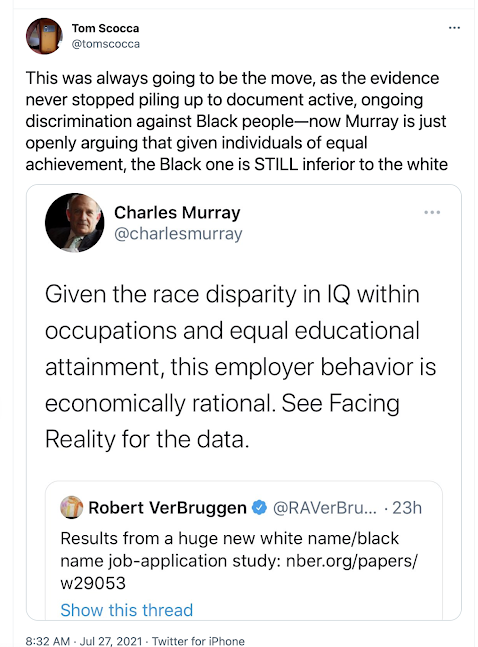
And if people like Murray had their way (Murray is also funded by Koch via AEI), it would be perfectly legal to discriminate in employment, on the basis of race.


But sure, let's listen to Steven Pinker and his rightwing goons whine about how politicized Science magazine is.

Thursday, January 13, 2022

The heritability fallacy

Although Pinkerite focuses most often on the political implications of the promotion and funding of race pseudoscience, every now and then I must get technical. 

Because, although most race pseudoscience promoters are obvious oafs, there are mainstream promoters of race pseudoscience, like Steven Pinker and Jonathan Haidt, who base their support for race pseudoscience on claims that, at a casual glance, seem like they might be true. 

The kind of claims that make people you'd think would know better, like Gideon Lewis-Kraus, write an article promoting the sociobiology politics of Kathryn Paige Harden, which implied the critics of her claims are anti-science.

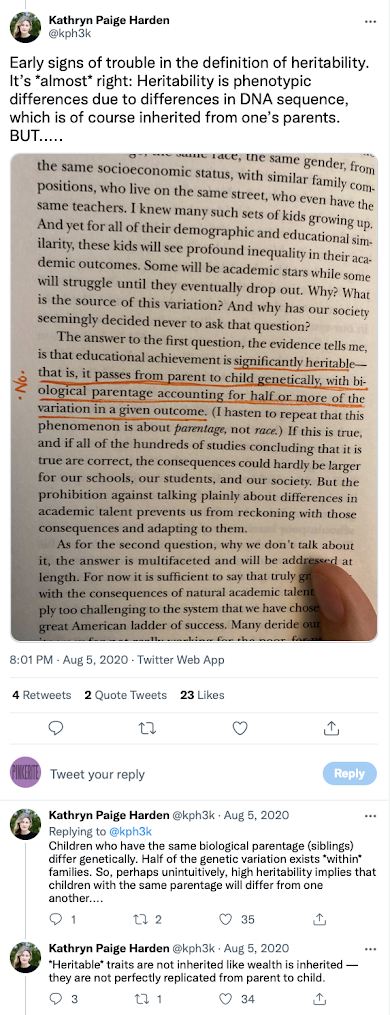
Harden's theories rest on the concept of heritability. Here we see Harden quibbling on Twitter with Freddie de Boer's use of the term, in a book which she generally likes.


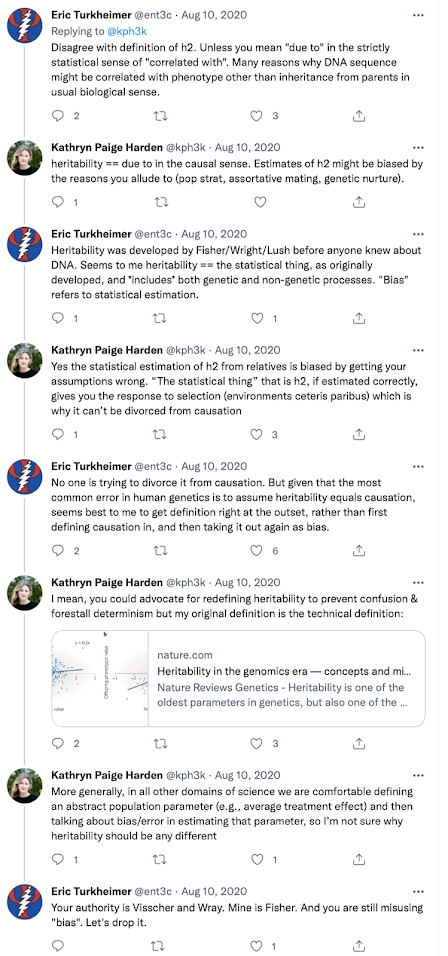
In the same thread, professor of psychology Eric Turkheimer argues with Harden about the terminology. We can see that even people thoroughly immersed in making arguments about heritability don't agree with each other about the term.

Unfortunately Turkheimer dropped the online debate. 

Harden then went on to publish a book "The Genetic Lottery: Why DNA Matters for Social Equality" making huge claims in favor of a sociobiological approach to social policy, and, in typical sociobiology fashion waxed dramatic, claiming that those who refused to accept her claims were no better than felons.

Late last year I wrote a post about the term "heritability" and how often it is misunderstood

Not long after, a Twitter friend pointed me to this excellent paper The heritability fallacy by David S. Moore and David Shenk:

For hundreds of years, the word ‘heritable’ was used without confusion as a synonym for ‘hereditary.’ But in the early 20th century, the word was repurposed to represent something new and rather narrow...

...The term heritability was first given this new meaning in J. L. Lush’s 1937 book Animal Breeding Plans.1 In that text, Lush proposed a calculation for what he called ‘heritability’ that neatly codified the then-popular deterministic viewpoint. Because, Lush argued, an animal’s phenotype (i.e., its observable traits, such as intelligence, height, eye color, etc.) is a function of genetic instructions plus the finishing influence of the environment, we should be able to statistically separate the influence of each. Relying on mathematical guidelines from the geneticist Sewall Wright, Lush proposed that in any given group:

Vp (phenotypic variation) = Vg (genetic variation)

+ Ve (environmental variation)

Lush asserted that the Vg portion of that total can reasonably be termed ‘heritability,’ as it revealed the portion of the trait variation that could be accounted for by variation in genes. The intention was ‘to quantify the level of predictability of passage of a biologically interesting phenotype from parent to offspring’. In this way, the new technical use of ‘heritability’ accurately reflected that period’s understanding of genetic determinism. Still, it was a curious appropriation of the term, because—even by the admission of its proponents— it was meant only to represent how variation in DNA relates to variation in traits across a population, not to be a measure of the actual influence of genes on the development of any given trait. For example, in a large group of people with eyes of different colors (Figure 1), ‘Vg’ only represents the extent to which variation in the group’s DNA accounts for variation in different eye colors in that group—not whether or how DNA is responsible for the development of eye color. In that sense, it was a highly misleading new use of the term (even in the context of determinism) that was bound to cause confusion: And indeed it did...

...because the term (if not its new-fangled scientific meaning) is so familiar to the public, the casual misinterpretation of the term’s narrower meaning has been rampant in the popular press. For many decades now, we have been entertained with journalistic accounts of twin studies suggesting that ‘personality is heritable’, ‘criminals are born, not made’, and ‘cheating genes play [a] large role in female infidelity’. Twin studies have reaffirmed the strong public impression that some physical and personality traits can be passed directly from parent to child through DNA. While understandable, this impression is flatly incorrect, as brightly illustrated by three significant flaws in some scientists’ use of— and thus the public’s understanding of—the term ‘heritability.’

The article concludes:

 Heritability statistics do remain useful in some limited circumstances, including selective breeding programs in which developmental environments can be strictly controlled. But in environments that are not controlled, these statistics do not tell us much. In light of this, numerous theorists have concluded that ‘the term “heritability,” which carries a strong conviction or connotation of something “[in]heritable” in the everyday sense, is no longer suitable for use in human genetics, and its use should be discontinued.’ Reviewing the evidence, we come to the same conclusion. Continued use of the term with respect to human traits spreads the demonstrably false notion that genes have some direct and isolated influence on traits. Instead, scientists need to help the public understand that all complex traits are a consequence of developmental processes. Without such an understanding, we are at risk of underestimating the extent to which environmental manipulations can have profoundly positive effects on development. Thus, the way ‘heritability’ is used in most discussions of human phenotypes not only perpetuates false ideas; it also blinds us to steps we might otherwise take to improve the human condition.

I am beginning to suspect that psychologists who work in genetics are reluctant to drop the term heritability because the confusion masks the fact that when it comes to the claims of people like de Boer and Harden, there is no there there

And you can see why there would be a temptation to maintain the facade. Statistics-based claims about genetics give the field of psychology a quantitative aspect it normally does not have. It gives the impression that psychologists are real scientists. And if you've staked your career on that, the confusion over the term "heritable" could save you from facing an eventual reckoning, at least for the length of your professional career.

Blog Archive

~