Featured Post

PZ Myers dissects evolutionary psychology: brief, sharp and fabulous

I admit I LOL'd at the part about lighting up "like a Christmas tree." WATCH AND LEARN all IDWs! (If you get that annoying...

~ PINKERITE TALKS TO ANTHROPOLOGISTS ~
The Brian Ferguson Interview
--------------------------------------------------------------------
Showing posts sorted by relevance for query lewis-kraus. Sort by date Show all posts

Tuesday, September 14, 2021

You and Your Racist Friend

Do They Might Be Giants make
Gideon Lewis-Kraus sad?


I wrote a critique of Gideon Lewis-Kraus' New Yorker piece on Kathryn Paige Harden
and I also emailed Lewis-Kraus a link to my post, saying I was disappointed with his take. And to my surprise, he wrote back.

Wow, and I thought I was disappointed in him before.

We went back and forth via email several times and among other things I pointed out that Razib Khan considers Harden a friend (Lewis-Kraus' article quotes the review in which Khan says this) and I said I would like to know what Harden thought of that and whether she considered Khan a friend. I said I wished Lewis-Kraus had asked her for the article.

His response:

No, she doesn't consider him a friend, but maybe one difference between us is that I don't have political litmus tests for my friends, and the prospect of a world in which people did that would be very depressing.

I can only assume Lewis-Kraus finds the song "You and Your Racist Friend" by They Might Be Giants horribly depressing.
This is where the party ends
I can't stand here listening to you
And your racist friend
I know politics bore you
But I feel like a hypocrite talking to you
And your racist friend
I mean, what a bullshit response. I'm sure he would not be friends with a Nazi. And Razib Khan is very close to that - a professional race-monger who agrees with Charles Murray that if we don't face the "truth" about Black American inferiority, we face DISASTER.
 
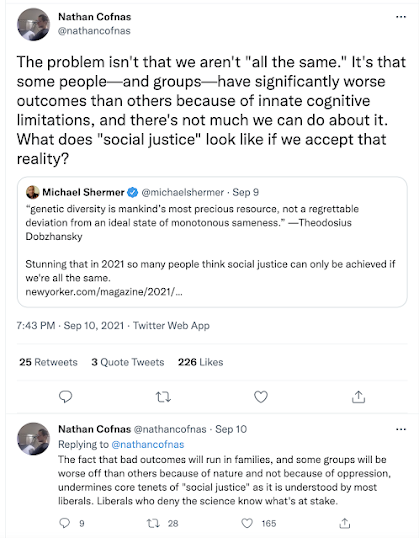
Lewis-Kraus' article prompted some of the racists and race-mongers on Twitter to remove all doubt that theirs is a political movement with straightforward goals. For instance, Quillette author Nathan Cofnas.


Gosh, what would "social justice" look like if we accepted unsupported hereditarian beliefs in the innate inferiority of Black Americans? Have there been any historical precedents for that?

Please note that Michael Shermer is in full agreement with Cofnas about race-based inferiority, the only quarrel is what form "social justice" should take.

One of the people who liked the first of the tweets above is a character who goes by the Twitter handle Indian Bronson, who, in December 2019, revealed he works for the Koch-funded AEI

Why would any non-racists be friends with people like this?

I believe Razib Khan and most other professional hereditarians got into race-mongering because wingnut welfare is lucrative and easy. 


But I'll be damned if I'll stop making it as unpleasant as I possibly can for them.

Now it should be noted that Lewis-Kraus also said:
Razib Khan is an irrelevant idiot. He has terrible views...
But is he irrelevant? He was relevant enough for Lewis-Kraus to quote him - giving him even more mainstream credibility (which Khan is happy to publicize) - in the Harden piece, and we know Khan has received money from rightwing extremist Ron Unz.

But there was something else that Lewis-Kraus wrote to me that makes me wonder if, in spite of it all, he is in denial about the threat in mainstreaming race pseudoscience. I'll discuss that next.

Monday, September 20, 2021

Behavioral Genetics and the Underpants Gnomes

Gotta go to work
Work all night
Search for underpants hey


Tom Scocca is Slate's politics editor.  His response to the Gideon Lewis-Kraus New Yorker profile of
Kathryn Paige Harden is so good
 it compelled me to subscribe to his Substack, called Indignity.

Scocca gets at the biggest issues with the whole damn Paige Harden business. The first being whether there is really a difference between "evolutionary psychology" and "behavioral genetics":

The phrenologists don't like being called "phrenologists." Even the archaic ones would tell you they were doing "anthropometry" or "craniometry," and the modern ones prefer to call themselves things like "evolutionary psychologists" or "behavior geneticists."
The more I learn about Harden style "behavioral genetics" the less difference I see between that and evolutionary psychology

In my email exchange with Lewis-Kraus, I suggested that Harden was one of many "evolutionary psychology-based researchers." 

Lewis-Kraus was not happy with my description:
Paige has nothing to do with evolutionary psychology, which she agrees is nonsense.
But I had recently found Harden on a page of the University of Texas at Austin website under the heading "Individual Differences and Evolutionary Psychology" and her profile was directly under one of the most prominent advocates of evolutionary psychology, David Buss.


Buss is such a reflexive believer in hereditarian explanations for human social phenomena he once suggested an example of female sexual slavery was a case of female sexual preference, as David Buller described in his book "Adapting Minds."

Scocca went farther than me, calling Harden a phrenologist.

At one point in my exchange with Lewis-Kraus, he wrote:
If you have emails between Pinker and Sailer, I will gladly review them. Otherwise, I think I'll hold my own counsel on the stories that I do, but thanks for the totally unsolicited and unwelcome advice. 
I hadn't offered him advice, I had expressed disappointment he didn't focus more on how politically-focused and well-funded race science is. But I don't think Lewis-Kraus was reading my emails carefully - his tone was hostile from his first response, seemingly appalled that I would dare to question his choice of framing at all.

Scocca was just as unhappy with Lewis-Kraus' framing as I was (my highlight):
Here's how Lewis-Kraus described Harden's own account of the tool she uses to address the most loaded social questions of our time:
GWAS simply provides a picture of how genes are correlated with success, or mental health, or criminality, for particular populations in a particular society at a particular time.....GWAS results are not "portable"; a study conducted on white Britons tells you little about people in Estonia or Nigeria.
That is, the genome makes people unequal, but it does so by an unclear mechanism, the effects of which are contingent on a person's social position in a particular time and place. Yet the reader was supposed to share Harden's regret or bafflement that Darity, a scholar of the material processes of racial inequality, would be hostile to her work.  
Behavioral genetics is an "unclear mechanism" being used to generate just-so stories.
Harden does not, in fact, study the question of how genes produce social outcomes. Frustrated by the slow progress of assigning clear social results to scientists' ever-more-complicated understanding of how genes operate, the behavior geneticists have simply skipped over the whole "how" business. Harden's work, Lewis-Kraus explained, relies on the use of the GWAS—genome-wide association study—in which computation is used "to identify hundreds or even thousands of places in the genome where differences in our DNA sequence could be correlated with a trait or an outcome." 
"[E]ven if researchers don't fully understand what they're learning, this is how the genome is used now," an unnamed population geneticist told Lewis-Kraus.
So behavioral genetics can be more succinctly, if less elegantly, expressed by the Underpants Gnomes.


Where Phase 1 is GWAS and Phase 3 is social outcomes. 

What bothered me most about Lewis-Kraus' email response was his belief that unless I can come up with personal correspondence between Steven Pinker and Steve Sailer, there's no point in writing about the politics behind contemporary race pseudoscience. 

But that's a general problem for mainstream media - their understanding of issues like Steven Pinker's promotion of race pseudoscience is hobbled by the fact that they are not in it for the long term. They dip into an issue, make shallow assessments (pretty young behavioral geneticist thinks leftists are anti-science!) and then move on. 

As long as Steven Pinker doesn't actually come out and say "I think that Black people are innately less intelligent" the cultural gatekeepers will yawn and look away, no matter how many race-mongers like Razib Khan and Linda Gottfredson, and race-mongering publications like Quillette, and racists like Sailer, Pinker has supported, in his role as respectable public intellectual.

Speaking of promoting race mongers, I see Julia Ioffe, a GQ correspondant, is also doing it. 

Have the New Yorker, Gideon Lewis-Kraus and Paige Harden made phrenology the hip new thing?


Monday, October 12, 2020

Reviewing David Reich's methods

Fantastic deep dive in the New York Times from January 2019 that I missed  - Is Ancient DNA Research Revealing New Truths — or Falling Into Old Traps by Gideon Lewis-Kraus

I hadn't been aware of Lewis-Kraus, even though I had read and liked his article about the Slate Star Codex for the New Yorker. I found he is highly esteemed, if a Twitter search on his name is any indication - lots and lots of praise for his work, which has covered a wide range of topics. To my amazement, he doesn't yet have a Wikipedia page, something I will find time to remedy soon.

The Lewis-Kraus DNA article focuses on David Reich and his dominance in the field of genetics. I've been interested in Reich since I discovered many hereditarians think Reich is on their side thanks to Reich's March 2018 NYTimes op-ed. This in spite of Reich's statement that race is a social construct. 

However, Lewis-Kraus makes an excellent point about Reich's op-ed:
He was careful to differentiate the idea of a genetic population from the old idea of race, which he agreed was a social rather than biological fact. But he nonetheless gave comfort to those who maintain that on the deepest of all levels our destiny is written into our genetic signature. It was hard not to see that conviction reflected in the findings of Reich’s papers, which seemed to blithely recapitulate discredited theories of Pacific expansion, making categorical claims not only about four individual skulls but about the shape of human history — claims that were essentially indistinguishable from the racialized notions of the swashbuckling imperial era.
Even more important to me, Lewis-Kraus provided a perfect illustration of the problem of trying to understand human societies strictly through genetics, which is something hereditarians Razib Khan and Sam Harris would like very much to do.

Lewis-Kraus:
A thought experiment might help to illustrate this. Imagine that the written history of our current era were lost to time, and paleogenomicists of the future were trying to explain the peopling of North America on the basis of a few bones that dated from between the 16th and 20th centuries. If these bones included the descendants of British, Spanish and French colonists as well as those of Yoruba slaves, the researchers might conclude that European migrants arrived together with African migrants and that their “sex-biased admixture” created the people known henceforth as Americans. From our perspective, those geneticists wouldn’t exactly be wrong about all this — but nobody would accuse them of being right, either.
That David Reich appears to indulge in the same type of thinking as Khan and Harris is a sign he might be more aligned with the hereditarian point of view than I previously realized. And Lewis-Kraus demonstrates that Reich is seemingly getting special treatment by the big science magazines, to the detriment of researchers using different methods and to the possible detriment of science itself:
I sat in the dark next to Frederique Valentin, a French bioarchaeologist who was an author on Reich’s original Vanuatu paper; it was she who made the final contribution that rescued the effort, the Tongan petrous bone. As it turns out, in 2015 she submitted a manuscript to Nature that made an almost identical argument to Reich’s. She had reached the same conclusions upon examination of the cranial morphology of the exact same skulls, which she believed more closely resembled those of Asians than those of Papuans. But her paper was rejected by Nature. As far as she or many others could tell, the only difference between her conclusions and Reich’s were those of methods — hers old, theirs shiny and new — and rhetorical grandeur. I asked if she thought that Reich’s definitive statements about Lapita origins were warranted.

“A small sample,” she replied, “is only representative of itself.”

The controversy over paleogenomics was becoming a near-ubiquitous presence in archaeology journals, and Bedford, as an author on all three Vanuatu papers, had recently written the introduction to an academic forum on the subject, in the journal Archaeology in Oceania. The evident differences between the two competing follow-ups put him in a bit of a bind, because his name was on both of them. “Both papers,” Bedford maintained, “arrive at a similar conclusion,” that initial Austronesian settlement was followed by a Papuan gene flow. But as the introduction continued, it became increasingly clear that he could not, in fact, at all believe that both could be right, and he tipped his hand in favor of the Jena paper, with its emphasis on an “incremental and complex” process that accorded much better with the artifactual record as he had spent his career understanding it.

There may be good reasons why the hereditarians think Reich is one of their guys.

Monday, September 6, 2021

The Left, the hereditarian Right and the New Yorker

I've spoken admiringly in the past of the work of Gideon Lewis-Kraus, in particular his in-depth look at the work of David Reich.

Lewis-Kraus has recently published an article in the New Yorker along a similar theme - left-leaning hereditarian whose work has provided some comfort to purveyors of race pseudoscience.

In this case it's an article about Kathryn Paige Harden entitled Can Progressives Be Convinced that Genetics Matter? which, as some on Twitter pointed out, is a bullshit question.


Something that really jumped out at me in the article (my highlights):

Harden has been merciless in her response to behavior geneticists whose disciplinary salesmanship—and perhaps worse—inadvertently indulges the extreme right. In her own review of Plomin’s book, she wrote, “Insisting that DNA matters is scientifically accurate; insisting that it is the only thing that matters is scientifically outlandish.” ​(Plomin told me that Harden misrepresented his intent. He added, “Good luck to Paige in convincing people who are engaged in the culture wars about this middle path she’s suggesting. . . . My view is it isn’t worth confronting people and arguing with them.”)

With the first review of Harden’s book, these dynamics played out on cue. Razib Khan, a conservative science blogger identified with the “human biodiversity” movement, wrote that he admired her presentation of the science but was put off by the book’s politics; though he notes that a colleague of his once heard Harden described as “Charles Murray in a skirt,” he clearly thinks the honorific was misplaced. “Alas, if you do not come to this work with Harden’s commitment to social justice, much of the non-scientific content will strike you as misguided, gratuitous and at times even unfair.” This did not prevent some on the Twitter left from expressing immediate disgust. Kevin Bird, who describes himself in his Twitter bio as a “radical scientist,” tweeted, “Personally, I wouldn’t be very happy if a race science guy thought my book was good.” Harden sighed when she recounted the exchange: “It’s always from both flanks. It felt like another miniature version of Harris on one side and Darity on the other.”
But Razib Khan isn't just a race science guy who thought Harden's book was good. Razib Khan considers Kathryn Paige Harden to be his friend:

My friend Kathryn Paige Harden’s The Genetic Lottery: Why DNA Matters For Social Equality is a well-written book that presents a somewhat tendentious position, at least to many of a progressive bent, that genetics must be considered when we design a liberal order. You can read my review over at UnHerd, though if you are subscribed to the paid version of this newsletter I’ll eventually be posting a much longer version of the review on this Substack.

How merciless can Harden be, if Razib Khan considers her a friend? I found that when I have been merciless towards the race pseudoscience of Razib Khan, he blocked me on Twitter. 

The New Yorker article mentions Quillette, Razib Khan and Charles Murray, but somehow neglects to mention that in July of this year, Khan wrote a positive review of Charles Murray's latest book for Quillette

And by the way, Khan declares Charles Murray to be his friend too. Is that how it works in the world of race-mongering? Friends always review the work of friends? 

The New Yorker piece demonstrates, contrary to its main theme, how much more extreme and politicized the hereditarian right is in comparison to the hereditarian left. 

Lewis-Kraus writes:

Her rhetoric is grand, though the practical implications, insofar as she discusses them, are not far removed from the mid-century social-democratic consensus—the priorities of, say, Hubert Humphrey. If genes play a significant role in educational attainment, then perhaps we ought to design our society such that you don’t need a college degree to secure health care.

As one Twitterer responded:


Meanwhile this is what the hereditarian right is saying. In his review of his friend Charles Murray's book, Razib Khan writes:

But why read a book on this topic when you can discover these facts within a few minutes? Tables on SAT scores by race are available in the Journal of Blacks In Higher Education, which pointed out in 2005 that “whites were more than seven times as likely as blacks to score 700 or above on the verbal SAT.” Wikipedia, meanwhile, has an entry entitled “Race and Crime in the United States,” which plainly states that a bit over 50 percent of victims and offenders in homicides are African American. The same website tells us that African Americans are about 13 percent of America’s population. Would you also be surprised to face the reality that the perpetrators of homicides are overwhelmingly young and male as well? These dots are there for anyone to connect if they like.

And yet very few choose to do so. Indeed, the failure—refusal, even—to connect the dots has become a vaunted feature, not a bug, of 2021’s regnant culture. Acknowledging unambiguous patterns of this kind will often result in the rebuke that some beliefs are divine mysteries, to be accepted on faith rather than analyzed more deeply. Which is precisely why Murray wants to inject these taboo realities into the intellectual bloodstream of our society. Despite being a brisk read, Murray’s short book lays out all the inferences and conclusions that remain lacunae in our public discourse. Without these facts on the table, the contemporary American debate has had to rely upon the ether of social science and nebulous theoretical explanations of “systemic racism” and “white supremacy.” Cognitive scientist Pascal Boyer has remarked that “theory is information for free,” and these are theories which purport to explain everything in American history.

How can this be interpreted in any way but "as long as we believe Black Americans are the victims of systemic racism and white supremacy we will not "connect the dots" about them and therefore fail to arrive at the truth: their real problem is their genetic inferiority"?

And this conclusion is not just something we can all agree to disagree about, according to Murray. As Khan writes earlier in the review:

The book’s thesis is that American society faces disaster if it is not prepared to confront certain politically uncomfortable facts about race—Murray has described it as a cri de coeur.
 
So according to the hereditarian right, we face DISASTER if we don't face the truth of Black American genetic inferiority.

That's quite a bit stronger than: "if genes are important then everybody should get healthcare."  

But for some reason, Lewis-Kraus, who has already acknowledged the existence of Quillette, Murray and Khan doesn't mention the review. Instead, when he mentions Quillette, it's part of a both-sides theme:

In Quillette, the researcher Richard Haier compared Harden and Turkheimer’s repudiation of Murray to climate-change denial—the second time in a year that Harden had been thus indicted, this time from the right.

Quillette published a review that says unless we acknowledge the genetic inferiority of Black Americans we face disaster. 

You would think that would be of some interest in an article that includes discussions of the dangers of race pseudoscience.

Richard Haier, it must be noted, writes for the far-right Federalist. In this tweet he reveals that Charles Murray is a political operative on the payroll of the Koch-funded AEI.


But of course this entire Pinkerite blog has demonstrated again and again how very well-financed the hereditarian right is by right-wing plutocrats. This is a hugely important issue in discussions of the political impact of hereditarianism, and one that Lewis-Kraus ignores. 

I'm very disappointed, New Yorker.

Sunday, April 6, 2025

What happened to Adam Rutherford? Part 3 ~ the nice kind of calipers

This should have been a clue about Rutherford
Kathryn Paige Harden has promoted the career 
of hereditarian racist Razib Khan, seen here celebrating
the wedding of extreme racist Curtis Yarvin.


As I've already discussed in Part 2, three of the ten authors of the Rutherford paper have given presentations at the racist/neo-Nazi-founded and infested International Society for Intelligence Research.

I'm sure if I continued to look I'd find even more connections between some of the authors and racists. 

Oops, I did it again. 

Tobias Wolfram,  who co-authored a paper with Rutherford co-author Felix C. Tropf   (mentioned in Part 2) - actually multiple papers - is a member of Jonathan Anomaly's genetic business (discussed further below and in the HOPE not Hate article The Superbaby Factory.)

I'm pretty good at spotting hereditarian racist names on sight, as a benefit, if you can call it that, of spending the past six and a half years tracking them, especially since I created a spreadsheet of attendees of ISIR annual meetings.

So I can't help noticing, just scanning down the References section of the Rutherford paper, the many hereditarian and even racist names there are, including David Buss, Kathryn Paige Harden, Francis Galton, Robert Plomin, Thomas. J. Bouchard, James J. Lee, R. A. Fisher and Gregory Clark. Clark is cited twice. The Economist noted:

One inescapable judgment is, as Mr Clark says, that “a completely meritocratic society would most likely also be one with limited social mobility.” He does not say that American blacks are poor because they are black. His work implies, however, that poor blacks remain so because they are descended from people with low social competence; discrimination is irrelevant, except to the extent that it limits intermarriage with other groups. “The Son Also Rises” may not be a racist book, but it certainly traffics in genetic determinism.

Clark "may not be a racist" - but I don't know how you could fail to understand that racism is the foundation of Clark's beliefs. 

As I've demonstrated in the many years of tracking them, you can't swing a dead cat in a group of hereditarians without hitting some racists.

The recent article in Undark, In Genetics, a Tense Coexistence of Mainstream and Fringe Views subtitled In an era of open data, genome-wide association studies have become entangled with efforts to prove Black inferiority noted (my highlights):

...when the educational attainment GWAS published in Nature Genetics in 2018, with Lee as the first author, it created a stir. At a website run by the Social Science Genetic Association Consortium, the authors shared detailed data known as summary statistics that allowed anyone with enough technical savvy to calculate polygenic scores for the datasets of their choosing. Scholars from an array of disciplines took notice, repurposing the data to see how well educational attainment polygenic scores predicted not just academic prowess, but related characteristics such as social mobility, political participation, and intelligence. 

(According to a recent report, at least one company is now using polygenic scores to screen IVF embryos for intelligence.)

If Kirkegaard approves, you've done something wrong.


I was somewhat disappointed in the article (in spite of getting a shout-out) because the author leaves out important hereditarian-racism connections. The article even fails to mention, directly, Kirkegaard's Neo-Nazi and racist network Human Diversity Foundation so well-investigated by HOPE not hate.

The article was so kind to Kirkegaard, that Kirkegaard expressed his approval of the article on Twitter.

Which is why my work here is never done. 

*** sigh ***

Kirkegaard can also be seen mocking Abdel Abdellaoui for saying that Kirkegaard is not on his team, but is that really true? I think hereditarians have more in common than not. 

We know that Abdellaoui has appeared on Razib Khan's podcast, where Khan referred to Abdelloaui as "a friend" and we know that Razib Khan has worked for Emil Kirkegaard's neo-Nazi network

So as much as Abdellaoui would not like to be embarrassed by being connected to a neo-Nazi, his friend Razib is not embarrassed. 

Hereditarians go through some impressive mental gymnastics to disassociate themselves from racists.

A favorite tactic of hereditarians, when you point out that they are soaking in racism, is to claim you are using the logical fallacy "guilt by association." It's an absolute favorite of Steven Pinker. No matter how many racists and racist organizations - even Neo Nazi organizations Steven Pinker has promoted for at least the past twenty-five years,  and no doubt will continue to promote, I expect he will go to his grave screaming "guilt by association."

Here is hereditarian Abdul Abdelloaui using the same tactic.

Two things about the Undark quote I highlighted above:

The first highlight demonstrates how certain hereditarians are that "educational attainment" is directly connected to intelligence. I know the passage mentions "social mobility" and "political participation" too. But for hereditarians, those things are related to intelligence, because everything is related to intelligence and intelligence is always genetic, in spite of the reflexive "of course the environment matters a bit" admission of the less shameless hereditarians. 

The reason they are so obsessed with "educational attainment," I believe, is because it's much easier to get data on the educational attainment of large groups of people, than to get data for intelligence test scores of large groups of people, since in many countries educating children is mandated by law, while intelligence tests are not.

And the belief that educational attainment is related to intelligence has existed in hereditarian-land since at least Arthur Jensen and The Bell Curve - and the International Society for Intelligence Research was founded by people who agree with Arthur Jensen and The Bell Curve.

And the second highlight demonstrates that even though hereditarian claims about intelligence genes are still unproven, racist hereditarians are not waiting for proof, thanks to the over-confident claims of the allegedly non-racist hereditarians.

The second highlight goes to an article about Johnny Anomaly and his eugenics business.  Anomaly is a long-time racist hereditarian seen here co-authoring an article with white nationalist Bo Winegard in Quillette. The article makes it clear that Anomaly and Winegard consider Kathryn Paige Harden's claims in her much-publicized book The Genetic Lottery proof of racist-hereditarian beliefs:

It is worth pointing out, however, that equality of opportunity is impossible to achieve. We can move in the direction of equalizing opportunities with carefully crafted redistributive policies. But even egalitarians who understand human nature, such as the behavioral geneticist Kathryn Paige Harden, know that we cannot truly equalize opportunities because people are born with unequal traits that are at least partially caused by different outcomes in a “genetic lottery.” We can make society open to talent, but we cannot distribute talent equally.

One of Bo Winegard's ideas to "equalize opportunities" is to have national race-based quotas to "preserve a country's (racial) demographic composition."


Jonathan Anomaly is one of five associates of Emil Kirkegaard currently suing Rational Media Foundation (RMF) with SLAPP suits because RMF's Rational Wiki articles about them have high-ranking search results which makes it easy to find all the racist beliefs and actions of Anomaly and the other plaintiffs: Michael A. Woodley of Menie, Russell T. WarneJan T. Nijenhuis and Jonatan Pallesen.

Like the article written by Anomaly and Winegard, the Rutherford paper refers to the work of Kathryn Paige Harden. Note 8 cites Harden (my highlight):

Social inequality is an inherently societal phenomenon driven by cultural, structural, economic, political and technological forces, although, as we show here, it is also associated with genetic variation. Although behavioural genetics research is actively examining the relationship between genetics and SES (8), most studies within the broader social sciences aiming to understand social inequalities tend to focus on societal factors (6,9.) By not including genetic effects, these studies omit a substantially contributing force that may be increasing in importance due to recent societal changes. When acknowledging these genetic effects, however, it is important to tread with caution. Recent history has shown that attempts to control the genetic make-up of populations—in the form of eugenics—can result in serious violations of human rights, including limiting access to edu-cation and labour markets, involuntary sterilization, infanticide, and genocide (10–12.)

SES means "Socio-Economic Status."

The line "By not including genetic effects, these studies omit a substantially contributing force that may be increasing in importance due to recent societal changes" has a faint echo of Harden comparing skeptics of hereditarianism to bank robbers:

The tacit collusion in some areas of the social sciences to ignore genetic differences… Is wrong. It is wrong in the way that robbing banks is wrong.

A writer in the white supremacist American Renaissance approved of that comparison.

A curious thing about the reference to eugenics, in the Rutherford paper, as pointed out by clinical psychologist Jay Joseph - it says nothing about the fact that the eugenicists were wrong, scientifically.


I think journalist Tom Scocca did a good job of cutting to the heart of the problem with Kathryn Paige Harden's claims in particular and behavioral genetics in general in his Substack post The nice kind of calipers


It is important to note here that Harden does not, in fact, study the question of how genes produce social outcomes. Frustrated by the slow progress of assigning clear social results to scientists' ever-more-complicated understanding of how genes operate, the behavior geneticists have simply skipped over the whole "how" business. Harden's work, Lewis-Kraus explained, relies on the use of the GWAS—genome-wide association study—in which computation is used "to identify hundreds or even thousands of places in the genome where differences in our DNA sequence could be correlated with a trait or an outcome." 

"[E]ven if researchers don't fully understand what they're learning, this is how the genome is used now," an unnamed population geneticist told Lewis-Kraus. 

Here's how Lewis-Kraus described Harden's own account of the tool she uses to address the most loaded social questions of our time:

GWAS simply provides a picture of how genes are correlated with success, or mental health, or criminality, for particular populations in a particular society at a particular time.....GWAS results are not "portable"; a study conducted on white Britons tells you little about people in Estonia or Nigeria.

That is, the genome makes people unequal, but it does so by an unclear mechanism, the effects of which are contingent on a person's social position in a particular time and place. Yet the reader was supposed to share Harden's regret or bafflement that Darity, a scholar of the material processes of racial inequality, would be hostile to her work.  

Meanwhile, here was Harden, in an email to Lewis-Kraus, putting a precise number on the effects of visible discrimination:

Even if we eliminated all inequalities in educational outcomes between sexes, all inequalities by family socioeconomic status, all inequalities between different schools (which as you know are very confounded with inequalities by race), we've only eliminated a bit more than a quarter of the inequalities in educational outcomes.

Those numbers may sound low to those of us who attended underfunded public schools. Is three quarters of the difference in educational outcomes between my Aberdeen (Maryland) High School Class of '89 and the Phillips Andover Academy Class of '89 really due to our lower-quality germ plasm? 

But Harden's message, the theory behind hereditarian leftism, is that there is no reason to believe that the effort to find inborn inequalities between people should lead to greater social inequality. Kraus-Lewis wrote, "Harden argues that an appreciation of the role of simple genetic luck—alongside all the other arbitrary lotteries of birth—will make us, as a society, more inclined to ensure that everyone has the opportunity to enjoy lives of dignity and comfort." 

This is the disclaimer that Murray and Herrnstein attached to The Bell Curve, in a pose of political neutrality. If we decide we know that some people are naturally disadvantaged at school and in our education-based system of economic opportunity, who is to say that our society won't decide to help those people out more, to make up for it? 

At least Murray and Herrnstein knew they were being cynical about this. Harden and her fellow hereditarian leftists seem to believe in phrenology as a neutral tool, an absurd position for self-styled empiricists to take. We have a long, detailed record of what happens when the skull calipers come out, and it's never an advance in equal treatment of all...

Although it's not helpful to publicly fret over whether phrenology, as Scocca prefers to call behavioral genetics, is bad for society. Doing so only convinces the hereditarians they are right and reinforces their image of themselves as Brave Pioneers of Science, unbowed by concerns that behavioral genetics will prove that the underclasses are on the bottom of the SES through no fault of the upper classes but their own genetically-endowed stupidity. A thing hereditarians believe, in all confidence, they have already proven, which is why Jonathan Anomaly's company, PolygenX:

...offers polygenic embryo screening and is a more advanced statistical analysis of the genomic sequence of fertilised embryos before they are implanted during IVF. In effect, it lets parents — who might typically generate 10 embryos during IVF treatment — select which one will be the likeliest to have certain traits. Of all the traits that PolygenX can identify, IQ was described by Tobias Wolfram to our undercover reporter as “basically the starting point of the company”.

In their review of Harden's book, Anne O'Connor (PhD Candidate in Sociocultural Anthropology), Brenna M. Henn, an associate professor of population genetics, Emily Klancher Merchant, assistant professor of Science and Technology Studies, and Tina Rulli, associate professor in the Department of Philosophy at UC Davis note the connection between Harden's and Jensen's views on educational attainment (my highlight):

DNA PLAYS A major role, indeed a starring role, in generating socioeconomic inequality in the United States, according to Kathryn Paige Harden, a behavioral geneticist at the University of Texas. In her provocative new book, The Genetic Lottery: Why DNA Matters for Social Equality, she contends that our genes predispose us to getting more or less education, which then largely determines our place in the social order. This argument isn’t new. It has appeared perhaps most notoriously in Arthur Jensen’s infamous 1969 article in the Harvard Educational Review (“How Much Can We Boost IQ and Scholastic Achievement?”) and in The Bell Curve by Richard Herrnstein and Charles Murray, published in 1994.

They also identify the slippery divide between genes and environment as described by behavioral geneticists (my highlight):

Harden expects that, as GWAS samples grow, the polygenic index will become more predictive, but exactly how it predicts educational attainment is not at all straightforward. Consider how Harden chooses to present the 10–15 percent figure, making it account for educational attainment through biological mechanisms. She tells her readers that the genes involved are expressed preferentially in our brains, where they increase the bearer’s intelligence, executive function, grit, and perseverance — the cognitive and non-cognitive skills rewarded in our educational system and labor market. What Harden doesn’t tell us is that these genes are also “expressed” in our environments. People with higher polygenic indices for educational attainment are both more likely to be raised by parents with higher socioeconomic status and to go to well-funded schools. A study of adoptees suggests that about half of the effect of the polygenic index operates through these indirect mechanisms. Harden acknowledges this complex causality, demonstrating that small differences early in life lead to children being placed into environments that magnify those differences. For her, these are all genetic causes because, with different genes, we also would experience different environments. By identifying social mechanisms as “genetic,” Harden is naturalizing them, attributing the inequality they produce to the individuals who benefit from or are harmed by them rather than to the policies and practices that privilege some genotypes over others.

A favorite tactic of hereditarians since the days of Henry E. Garett is to claim that critics of hereditarianism only care about moral/political issues not scientific ones. In their New York Review of Books piece, M.W. Feldman, Professor of Biology and Jessica Riskin, Professor of History note Harden pulling the same tactic with the hereditarian bête noire (along with Stephen Jay Gould), the late Richard Lewontin:

Such talk of entanglements and braids is misleading, implying that genetics and environment are discrete strands, when in fact living things are in continual interaction with their environments in ways that transform both at every level. The late Harvard evolutionary biologist and geneticist Richard Lewontin used the concept of the “reaction norm”—a curve expressing the relation between genotype and phenotype as a function of the environment—to describe this interaction and its implications. Lewontin showed that since the relationship between genotype and phenotype depends on the environment in which the phenotype is measured, one can’t infer genetic causes from correlation and regression calculations. Harden mentions Lewontin as a critic of behavioral genetics, but she implies that he didn’t approve of the field simply on ideological grounds. She never mentions or engages with his substantive refutation of the core assumption that genetic and environmental causes of behavior are separable.

The review describes the weakness of GWAS-based hereditarian claims (my highlights):

Explaining how social scientists make genome-wide association studies and polygenic scores, Harden writes:

Correlations between individual SNPs and a phenotype are estimated in a “Discovery GWAS” with a large sample size…. Then, a new person’s DNA is measured. The number of minor alleles (0, 1, or 2) in this individual’s genome is counted for each SNP, and this number is weighted by the GWAS estimate of the correlation between the SNP and the phenotype, yielding a polygenic index.

This alphabet soup in the passive voice implies that no one actively does all this estimating, measuring, counting, weighting, correlating—or that these are such technical processes that any human presence in them is irrelevant. But people are making interpretive decisions at every stage: how to define a phenotype and select people to represent it, how to count these people, which single-nucleotide polymorphisms to consider, how to weight and aggregate them. Interpretive decisions are of course essential to all science, but here there are a great many opinions dressed up in facts’ clothing. “This polygenic index will be normally distributed,” Harden continues, now disguising an assumption—that there are intrinsic cognitive and personality traits whose distribution in a population follows a bell-shaped curve, a founding axiom of eugenics—as an objective fact. Harden then tells us that “a polygenic index created from the educational attainment GWAS typically captures about 10–15 percent of the variance in outcomes.” All these trappings of scientific objectivity notwithstanding, a polygenic index “captures” differences in educational outcomes the way Jackson Pollock’s Summertime painting captures the season: as a reflection of its creator’s radically subjective view of things (which is just fine for abstract expressionism).

If you find a magical hammer that, whenever you swing it, rewards you with funding and professional advancement, you look at your research area and see nothing but nails. Genome-wide association studies are the social sciences’ new magical hammer. Macular degeneration seems plausibly to be a nail: genomic analysis revealed two sets of single-nucleotide polymorphisms that were importantly associated with having the disease. Schizophrenia appears not to be a nail, though it might have some structural features a hammer could help with. The things social scientists have been swinging at aren’t just non-nails. They are to nails as ships to sealing wax, as cabbages to kings. To suggest that macular degeneration has genetic causes is to make an empirically testable proposal; to suggest that “grit” or “openness to experience” has genetic causes is to make a category mistake. These are interpretive descriptions, made of ideas, opinions, and practices, not molecules.

But as we've seen with the Rutherford paper, the weakness of their claims does not stop hereditarians from promoting the hell out of the "magical hammer" in exactly the same way that Steven Pinker and Nicholas Wade did not wait for the "Natural History of Ashkenazi Intelligence" hypothesis to be proven - or even tested - before promoting it via the New York Times and through lectures.

Hereditarians have plenty of motivation to claim to wield the nice kind of calipers: it could damage their careers if they are found to be too racist, as Razib Khan discovered (probably why he hates NYTimes op-ed writer Jamelle Bouie so much) and as Jonathan Anomaly complains in his SLAPP lawsuit against the Rational Media Foundation for their Rational Wiki entry on Anomaly:

131.In October 2021, Dr. Anomaly was under consideration for a teaching position at Lingnan University in Hong Kong. Dr. Anomaly underwent a series of job interviews for the position, over the internet via videoconference. Faculty members responsible for making a hiring determination regarded Dr. Anomaly as an outstanding candidate, and he was advanced to the final round of interviews.

132.During the final interview, one of the faculty members conducting the interview began searching Google for Dr. Anomaly’s name, and was exposed the RationalWiki article about him. Despite the other faculty members responsible for the determination all wishing to hire Dr. Anomaly, the faculty member who was exposed to the RationalWiki article objected so strongly that Dr. Anomaly was withdrawn from consideration for the position.

133.Dr. Anomaly’s business and academic opportunities continue to be placed in jeopardy (exactly as they were when he interviewed with Lingnan University) as a result of the RationalWiki article and its appearance in Google search results, causing Dr. Anomaly ongoing financial damages as well as mental anguish and suffering.

Like I said, you can't swing a dead cat...

According to the HOPE not Hate article: (my highlights)

In late 2023, HOPE not hate’s undercover reporter posed as a potential customer in the process of beginning IVF with his partner, and was quoted a price of $50,000 to use PolygenX. He was referred by Malcolm and Simone, the American pronatalist couple and had several meetings with company leaders. Our infiltrator met Jonathan Anomaly, who is described in one of his books as the company’s co-founder; the CEO Michael Christensen; and Tobias Wolfram, who was introduced as the Chief Science Officer. They told our reporter that at PolygenX, they had invented an extraordinary product.

More about Tobias Wolfram: (my highlights)

We can reveal that Wolfram has been a member of the closed Telegram chat of Martin Sellner, the Austrian far-right activist who leads the Identitarian Movement (Identitäre Bewegung). In January 2024, Wolfram posted the anti-immigrant slogan “we were never asked” in the channel, which is closed to members of the public. He posted again in the same chat in April to criticise a leaflet organising a counter-protest against Martin Sellner in Steyregg, Austria.

In response to HOPE no hate’s findings, Wolfram’s representatives told us that he “vehemently denies being associated with the ‘far-right’, rather he considers himself a libertarian”. His representatives furthermore told us that Wolfram was unaware that he had been posting in Martin Sellner’s private chat group on Telegram. They added: “Immediately upon realising that the post was on Mr Sellner’s channel, Mr Wolfram removed it.”

So why do hereditarians, the ones who sincerely consider themselves anti-racist, work with and aid and abet racists so often? 

Is it because they don't care that their weak, but confidently-promoted speculation that educational attainment signifies intelligence leads to the conclusion that those who achieve higher education have done so primarily through genetic superiority?

Maybe that's why they rarely have a serious response to criticisms of hereditarianism, and instead are often flippant and contemptuous as both Adam Rutherford and Abdel Abdellaoui have demonstrated


To understand how far hereditarians are willing to take their belief that genes are everything, here is Richard Haier, devotee of Arthur Jensen, explaining to racist Stephan Molyneux that we can improve intelligence through genetic manipulation, which is basically what Jonathan Anomaly thinks he is doing.

Haier:

Well, unfortunately now in our country we're living in a time that's profoundly anti-science. We have many government heads and important agencies who are overtly anti-science. I don't understand it, but it's not good. And it's not good in general for for many scientific things and for the kind of things we're talking about here, which are kind of far out. Not many people are talking about manipulating genes that raise IQ. This is not really a public conversation, and to the extent it is, it's usually framed in some negative context of eugenics or or racism or or or or something like that.

Abdel Abdellaoui can be seen on Twitter promoting Richard Haier's work.

So Abdellaoui promotes Richard Haier, but he's tried to impede Emil Kirkegaard. Yet both Haier and Kirkegaard admire Arthur Jensen whose claim to fame is his racist hereditarian beliefs. Kirkegaard created this website to honor Jensen. Haier described Jensen as one of his heroes

It's impossible to avoid the inference that Adbellaoui's problem with Kirkegaard is not due to his racist hereditarian beliefs.

Perhaps the conclusion we can draw from these feckless hereditarians, all of them very well-educated, is that educational attainment is correlated with incredible self-certainty and extreme stupidity.

So what is this heritability that hereditarians are always talking about? That's in Part 4.


Tuesday, December 7, 2021

The problem with "heritability"

I've been thinking about this for several months now, about what to do with this word, "heritability."

The problem is that it is often used in reference to genetics, but it can either mean "something caused by genetics" or "something not caused by genetics."

For example:

Today, researchers rely on genome-wide association studies (GWAS) to find the genetic variants that are relevant to a specific trait. In GWAS the genomes of individuals are analyzed to see if particular genetic variants are correlated with variation in traits of interest. GWAS results have identified hundreds of variants underlying phenotypic variation in humans, mice, fruit flies, rice, maize, and many other taxa. Yet, despite the large number of alleles that have been identified using this technique, the amount of phenotypic variation they explain is just a fraction of what twin and pedigree studies predict is heritable. For example, twin studies have shown that approximately 80% of variation in human height can be explained by genetic factors (Silventoinen et al., 2012). However, the results of the best powered GWAS only explain around 20% of such variation (Wood et al., 2014). This gap is known as the ‘missing heritability problem’.

The "missing heritability problem" is pretty clearly a problem with predictions about genetics - far less evidence has been found, than was anticipated, for specific genes influencing specific human traits.

And yet, for example, educational attainment is also said to be an "heritable" trait :

SNP heritability increased with socioeconomic deprivation for fluid intelligence, educational attainment, and years of education. Polygenic scores were also found to interact with socioeconomic deprivation, where the effects of the scores increased with increasing deprivation for all traits.

"Years of education" is a social phenomenon, not a genetic one. But it is still called "hereditable."

To give one extreme example: in American chattel slavery, not only were slaves rarely taught to read, they were often actively prevented from learning to read. So illiteracy could be said to be highly "heritable" in American slaves - the children of slaves were about as likely to be illiterate as their parents. But obviously this has nothing to do with a genetic ability to learn how to read.

The way heritable is used, it sounds like it describes an action - as if "heritable" educational attainment is the act of passing down educational attainment from one generation to the next. 

Instead "heritable" is the observation that nothing has changed from one generation to the next. "Heritable" is nothing more than a statistical description of stasis.

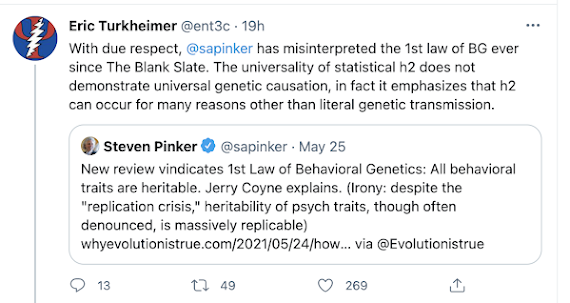
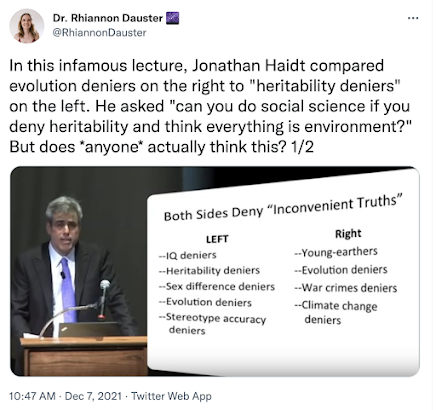
Apparently Steven Pinker and Jonathan Haidt (a Koch money beneficiary via Heterodox Academy) both believe the term "heritability" means "genetic."

But hereditarians would want to believe "heritability" means "genetic" because their answer to everything is "genes."

I have long joked that the "nature assumption" is so strong among promoters of sociobiology that this is how they do their studies:

Step one: observe a human behavior

Step two: declare the cause "genetics"

Step three: write a paper declaring the victory of nature over nurture

The term "nature assumption" is a nod to that darling of biosocial criminology,  Judith Rich Harris, who wrote "The Nuture Assumption" and who, I recently discovered, was hugely influenced by Steven Pinker, which I will discuss in a future post.

Recently hereditarians were taking yet another premature victory lap for nature over nurture, this time based on claims by "behavioral geneticist" Kathryn Paige Harden. Those claims were immediately assumed to be a victory for race pseudoscience by people like Quillette author Nathan Cofnas:


The fecklessness of sociobiologists was what annoyed Tom Scocca so much in his response to the New Yorker article about Harden written by Gideon Lewis-Kraus:

Here's how Lewis-Kraus described Harden's own account of the tool she uses to address the most loaded social questions of our time:
GWAS simply provides a picture of how genes are correlated with success, or mental health, or criminality, for particular populations in a particular society at a particular time.....GWAS results are not "portable"; a study conducted on white Britons tells you little about people in Estonia or Nigeria.
That is, the genome makes people unequal, but it does so by an unclear mechanism, the effects of which are contingent on a person's social position in a particular time and place. Yet the reader was supposed to share Harden's regret or bafflement that Darity, a scholar of the material processes of racial inequality, would be hostile to her work.

In other words, Harden absolutely does not have evidence for the claim that correlations between some social conditions and some GWAS results are caused by genes, but nevertheless she goes ahead and makes that claim.

And not only makes the claim - she compares those who have doubts about her claim with bank robbers. But being a drama queen seems to be a pretty common trait, over the years, among promoters of sociobiology and its many sub-categories: evolutionary psychology, behavioral genetics, race science, etc. Is "drama queen" an heritable trait for sociobiologists?

Monday, October 20, 2025

Steven Pinker: still undefeated as the world's biggest weasel


"Ferahgo the Assassin," by Steven Pinker's
on FacebookWilloughby borrowed the 
character's name as a pseudonym while 
writing in support of race pseudoscience. 
It's too perfect that a Pinker ally 
identifies with a humanoid weasel.

--------------------------------------------------------
Although Steven Pinker was originally dubbed the world's most annoying man by someone else, I originated calling him a weasel. But I confess that while reading some of Pinker's latest book "When Everyone Knows That Everyone Knows..." I found the flagrance of his weasellitude so breathtaking I'm amazed I was able to write about it outside of an oxygen tent.

In the chapter "The Instinct to Cancel" Pinker argues that it were better if we not discuss race and intelligence in public.

Fear not, Pinker has not given up on race pseudoscience.

I was alerted to Pinker's position by those who have the greatest self-interest in talking about race and intelligence because they have staked their entire careers and livelihoods on the issue: the neo-Nazis at Aporia Magazine.

In an article in Aporia called 'Pinker is wrong. We should "go there"' neo-Nazi Bo Winegard says:

Few topics inspire bad arguments as reliably as race differences in intelligence. So often have I responded to them that I have plausibly been accused of obsession. But as long as the bad arguments persist, someone must respond. Consider it a public service.

But of course Winegard is not doing anything as a "public service" - this is his full-time job. He works for Emil Kirkegaard's race pseudoscience and Nazi network, so brilliantly exposed by Hope not Hate a year ago:

In recent months, however, Aporia has dropped its pretence of balance, as evidenced by the interview that eventually took place with (Jared) Taylor in May 2024. Taylor’s interlocutor was Bo Winegard, Aporia’s new executive editor, who, on the website, has called upon his readers to “​​embrace” white identity politics and believes racial stereotypes are “reasonably accurate.”

That's not to say that Winegard is only doing it for the money. I'm prepared to accept that Winegard is such a dullard he truly believes in race pseudoscience, that collection of pre-20th century European folklores presented as science from Social Darwinism to eugenics to Nazism to sociobiology to evolutionary psychology to behavioral genetics

I'm in favor of publicly discussing race and intelligence claims so that people who are not right-wing psychologists can gasp in wonder at how stupid race pseudoscience really is.

In the next paragraph, Winegard states why Pinker is so useful to the cause of race pseudoscience:

The latest comes from Steven Pinker’s new book, When Everyone Knows That Everyone Knows… It deserves attention precisely because it comes from Pinker, a celebrated academic and an outspoken defender of free speech and open inquiry. This is not some indignant progressive who made a career of castigating “racist pseudoscience”, but a rational centrist who has long argued against the left’s denial of human nature.

Pinker's also been called a "celebrity intellectual" by the New York Times.

In "When Everyone Knows...," Pinker makes the case for race pseudoscience while pretending to weigh the pros and cons of discussing the issue:

The case for not going there, to be sure, has many problems. It’s almost impossible to enforce. It faces the polar bear paradox: telling people not to think about an idea forces them to think about the idea. It may be hard to draw the line around the no-go zone so that it doesn’t swallow up neighboring territories, like the study of intelligence or of continental ancestry. It forecloses the possibility of obtaining decisive evidence that racial differences are wholly environmental and eliminable, with all the social benefits that would bring.

And it may be too late. Our era is obsessed with racial differences, attributing them unquestioningly to racism, which only invites curious people to wonder whether they might be attributed to other causes, intensifying the regime that criminalizes such curiosity. As the writer Coleman Hughes has argued, there are good reasons for even the most open-minded people to want to keep the issue of race and intelligence out of mainstream conversation. But that tacit agreement should be a part of a larger commitment to color-blind policies in public and private life.

Coleman Hughes is in a tough spot - he's Black but has taken money from race pseudoscience-promoting Quillette -  so it is in his self-interest to "want to keep the issue of race and intelligence out of mainstream conversation." With Pinker's apparent approval, Hughes offers a deal on behalf of hereditarians along the lines of: "we won't mention that Blacks are genetically inferior if you promise to stop making efforts to ameliorate systemic racism via programs like DEI." 

Pinker hates DEI.

Pinker is so comfortable with race pseudoscience that this year he had a byline in Aporia, then appeared on the Aporia podcast.

For Pinker, being a true believer in race pseudoscience has only ever been a minor inconvenience in his progress as a celebrity intellectual. I've found only three times when the issue was raised by the mainstream press: 
I am convinced that Pinker's strategy, in order to promote race pseudoscience while maintaining a career as a celebrated academic/rational centrist/celebrity intellectual, is to loudly claim he is opposed to racism - he told the Guardian that racism was stupid - while at the same time promoting the careers of racists who will go there for him, from Sailer, to Razib Khan, to Linda Gottfredson to Claire Lehmann to Richard Hanania to Bo Winegard

In his book, Pinker mentions the ISIR meeting participant Cory Clark with approval a couple of times (including to mention she's co-authored a paper with him) but doesn't mention she has worked for Emil Kirkegaard, and when he notes another paper Clark co-authored, fails to mention Bo Winegard is one of the co-authors.

Because that's just the kind of weasel that Steven Pinker is. 

The book's reference section includes racists, hereditarians, evolutionary psychologists and right-wing reactionaries: Lee Jussim, Nathan Cofnas, Roy Baumeister, David Buss, Richard Dawkins, Alice Dreger, Jonathan Haidt, Carole Hooven, Eric Kaufmann, Greg Lukianoff, Donald Symons, Lawrence Summers, John Tooby, Leda Cosmides and Matt Yglesias.

Pinker talks about journalists muzzling themselves:

Journalists, too, despite their ironclad commitment to freedom of the press, muzzle themselves in particular circumstances. They may, for example, choose not to identify confidential sources, juvenile suspects, the victims of sexual assault, or details surrounding prominent suicides. They may decline to publish the manifestos of rampage shooters, or train a camera on sports fans running onto the field.

But he doesn't seem to appreciate how this has helped his career, how his weasellitude is enabled by most journalists being too chummy with celebrity intellectuals to dare ask anything potentially embarrassing. After all, Pinker might get huffy as he did when the Guardian dared ask:

Angela Saini, a science journalist and author of Superior: The Return of Race Science, told me that “for many people, Pinker’s willingness to entertain the work of individuals who are on the far right and white supremacists has gone beyond the pale”. When I put these kinds of criticisms to Pinker, he called it the fallacy of “guilt by association” – just because Sailer and others have objectionable views, doesn’t mean their data is bad. Pinker has condemned racism – he told me it was “not just wrong but stupid” – but published Sailer’s work in an edited volume in 2004, and quotes Sailer’s positive review of Better Angels, among many others, on his website..

I know exactly how high the bar is for journalists to care about the pro-racism activities of celebrity intellectuals like Pinker. Back when the New Yorker was helping to promote behavioral genetics via a glowing profile of Kathryn Paige Harden, I had a brief exchange of emails with the profile's author Gideon Lewis-Kraus, a frequent New Yorker contributor. He said:

If you have emails between Pinker and Sailer, I will gladly review them. Otherwise, I think I'll hold my own counsel on the stories that I do... 

Now we do know about letters between E. O. Wilson and ultra-racist J. Philippe Rushton, which did seem to convince some people that Wilson was a racist. But the reason the correspondence was significant was that it provided evidence that Wilson used his celebrity intellectual powers to help advance Rushton's career.

But we don't need emails between Pinker and Sailer, there is plenty of evidence that Pinker has helped to promote the career of Sailer and many other racists as I've documented for the past seven years on this blog. And by the way, Pinker could be seen promoting Rushton too, on Boing Boing in 2009.

For journalists like Lewis-Kraus, which is almost all of them, Pinker can promote all the racists and appear on all the neo-Nazis podcasts in the world, he will always be acceptable as long as he doesn't record a precise declaration of his beliefs. The rest of us are forbidden from drawing conclusions based merely on a quarter century of Pinker's activities.

But if Pinker making common cause with neo-Nazis does not faze journalists (except the Guardian), I doubt anything will.

Blog Archive

~